Narcissus
Zhao Mengjian · mid-13th century
Explore the painting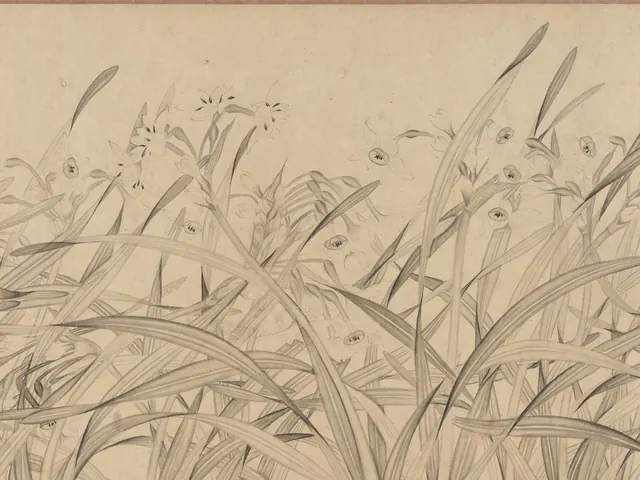
Zhao Mengjian drew these dense clusters of narcissus in the mid-thirteenth century. A member of the Song imperial family, he practiced calligraphy and painting and was particularly known for this flower. The scroll contains little besides plants. Later viewers connected it with the dynasty’s fall. Yet the painter died before the final Mongol conquest of the Southern Song in 1279. Political memory entered the work through its subsequent reception.
Thin lines outline petals near the upper edge. The light surface left open by the ink supplies much of the flowers’ whiteness. The painter distinguishes frontal and side views, open blooms and inclined heads. Variety emerges within a single species. A change in stem direction, spacing, and a few lines is enough to keep the blossoms distinct.
Long leaves cross at different angles. Some show their broad surfaces, others almost an edge. Many individual intersections create density while remaining legible. The method is close to calligraphy, where a line carries both the form of a sign and the movement of a hand. Here the stroke’s individuality accompanies attention to a particular plant.
Chinese literary culture associated the narcissus with water divinities. Its name, shuixian, refers to a water immortal, while poetic comparisons invoke the goddesses of the Xiang River. Through this tradition, the flower could also recall Qu Yuan, a poet and loyal official who died in water. Such connections made an unassuming plant suitable for reflection on loyalty and loss.
Flowers continue along the scroll, changing position within a consistent arrangement of leaves and stems. Qiu Yuan later added a poem that the museum reads in relation to life after the conquest. The plants acquired the meaning of surviving remnants in a devastated world. This interpretation belongs to the next generation. An object made before political catastrophe could become its memorial for those who lived through it.
The lower leaves form an especially close interlacing. Lin Zhong, whose inscription survives with the scroll, drew attention to its combination of density and refinement. He compared the work with sparser narcissus arrangements in other painting. Historical viewers considered more than loyalty to a fallen dynasty. They also discussed pictorial fullness and the skill needed to sustain such intricate botanical drawing.
The image gradually accumulated poems, seals, and collectors’ testimony. Those additions are largely outside the floral detail displayed here, but they form a substantial part of the scroll’s history. Its story belongs to several periods. The painter made plants, later poets expressed historical loss through them, and collectors evaluated the drawing while preserving earlier responses. No single voice exhausts the work.
- Medium
- Handscroll; ink on paper
- Collection
- The Metropolitan Museum of Art
- Dimensions
- Image, 33.2 × 374 cm
- Accession number
- 1973.120.4
Sources
Image provided under CC0. A detail of the scroll. The complete work extends beyond this museum reproduction. Image licence