The Crucifixion with the Virgin and Saint John
Hendrick ter Brugghen · ca. 1624–25
Explore the painting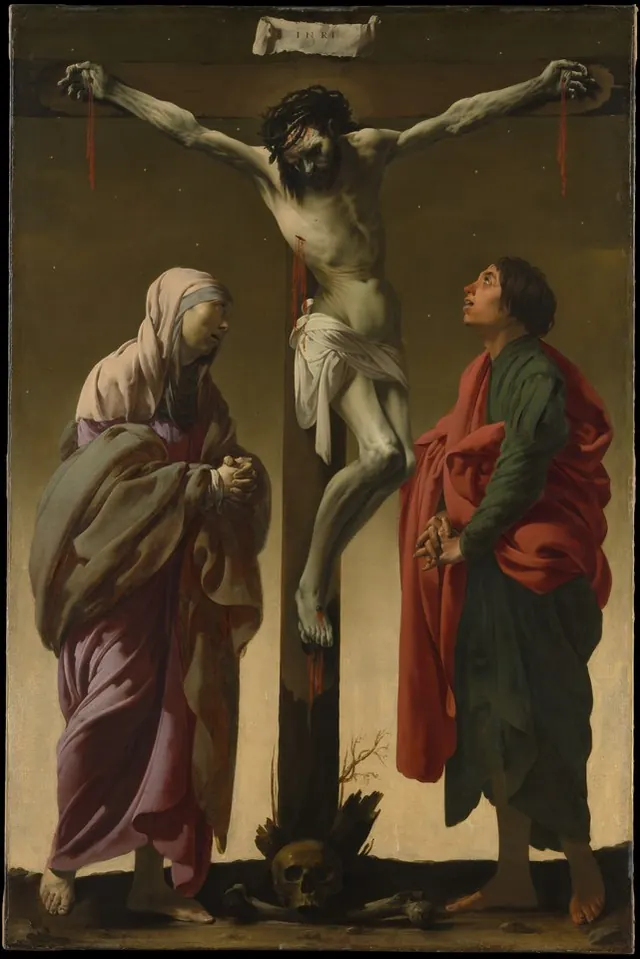
Ter Brugghen painted this Crucifixion around 1624–25 while deliberately giving it features of much older painting. The painting is thought to have served private Catholic devotion. Early German pictures were familiar to seventeenth-century collectors, and their austere expressiveness offered a way to concentrate on Christ’s suffering.
Christ’s head falls forward, his arms stretch sharply, and ribs project beneath the skin. The body hangs between its points of attachment. There is no triumphant gesture. The Christian doctrine of redemption is presented through bodily vulnerability, intended for sustained devotional attention.
Blood stands out against pale skin and cloth. The painter does not dissolve the wounds into a general glow. Their precision connects the religious subject with physical injury. Such an image could support prayer that involved imagining the Passion, experiencing compassion, and remembering the cost of salvation.
The Virgin at the left brings her hands together. Heavy garments form an enclosed figure. She turns toward her crucified son while remaining on the ground. Her contained pose and Christ’s exposed body show suffering in different ways, through injury and through a witness’s gesture.
John at the right raises his face toward the cross. Together with Mary, he creates an almost symmetrical setting for the central figure. A small group is rigorously organized. The viewer does not have to locate the central event among soldiers, spectators, or other Gospel episodes.
A dark sky scattered with stars lies behind the cross. Its flatness contrasts with the tangible foreground figures. An archaizing background coexists with convincingly illuminated flesh. Looking to earlier art in the seventeenth century could be a deliberate expressive choice.
The work offers a particular closeness to sacred history. A few figures, wounds, and a nearly motionless composition sustain attention to one event. For an owner, its old-fashioned appearance could suggest religious continuity; for a collector, it also demonstrated a contemporary master’s command of earlier art. Those functions could coexist in one household.
- Medium
- Oil on canvas
- Collection
- The Metropolitan Museum of Art
- Dimensions
- 154.9 × 102.2 cm
- Accession number
- 56.228
Sources
Image provided under CC0. Image licence