The Musicians
Caravaggio · 1597
Explore the painting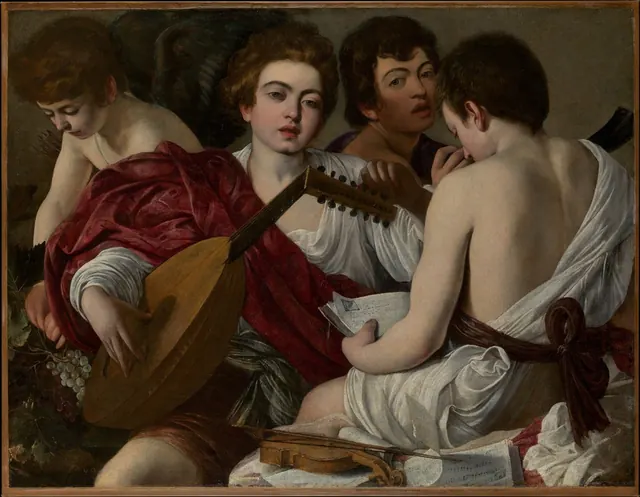
The musicians are still preparing. The lute is being tuned, a score is being read, and a violin lies before the viewer. Caravaggio painted the work in 1597 for Cardinal Francesco Maria del Monte, his first major patron. Musical gatherings took place in the cardinal’s Roman household. The young painter found accommodation, support, and an audience receptive to his unusual combination of everyday observation and classical invention.
The lutenist reaches toward the instrument’s pegs. Parted lips and lifted eyes give the preparation bodily immediacy. Antique dress does not turn the young man into a remote statue. Light falls on the cheeks and shoulders of someone standing close to us.
The figure at the right turns his back. His shoulder obscures the others, as though the viewer had approached a closely gathered group. This is how the painting constructs intimacy. It withholds an unobstructed stage view while placing us beside instruments and open music.
The score connects the image to a particular repertoire. In an Accademia Carrara publication, scholar Paolo Plebani reports its identification as a six-part madrigal by Pompeo Stabile, setting Jacopo Sannazzaro’s verses about Icarus. Music in this setting joined performance, poetry, and discussion of antiquity. A household audience could value all three.
At the left, Cupid has a dark wing and grapes. His presence gives domestic music-making an allegorical dimension. Love joins the gathering almost as another young man. Caravaggio keeps myth and familiar life distinct while giving them shared bodies, light, and space.
The young man in the background, second from the right, is identified as Caravaggio himself. The painter places himself inside an activity his patron valued. This is both an authorial presence and an image of membership in the cardinal’s cultural circle. Art emerges here through dependence, hospitality, and shared prestige.
Cardinal del Monte’s household belonged to an educated private culture within the ecclesiastical elite. Classical poetry and music were valued here, and sensuous paintings of mythological figures were commissioned to decorate its rooms. Del Monte’s support enabled Caravaggio to develop paintings in which mythological figures acquired the immediacy of living people.
- Medium
- Oil on canvas
- Collection
- The Metropolitan Museum of Art
- Dimensions
- 92.1 × 118.4 cm
- Accession number
- 52.81
Sources
Image provided under CC0. Image licence