The Meditation on the Passion
Vittore Carpaccio · ca. 1490
Explore the painting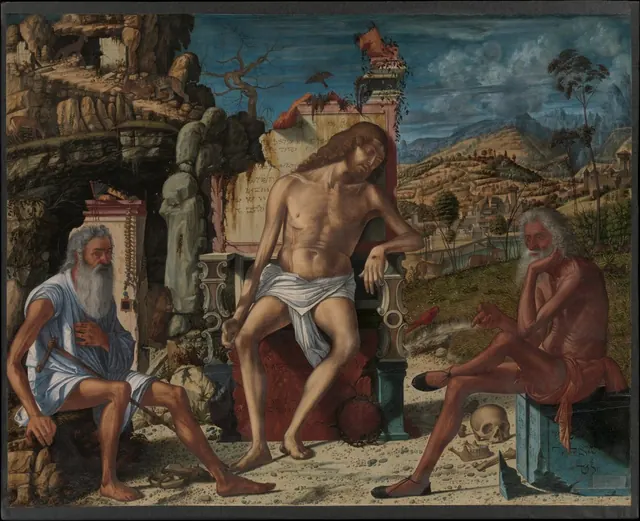
The dead Christ sits on a broken throne between two people who could never have met during his lifetime. Job from the Old Testament is at the right; Saint Jerome, who lived centuries after the Crucifixion, is at the left. Around 1490, Carpaccio created an image for meditation on suffering. Christian reading of scripture brings different ages together.
A high seat supports Christ’s body. His head falls to one side and one hand hangs from the armrest. Christian devotion recognizes the authority of someone shown without bodily strength. The damaged throne sharpens that disparity.
Job sits at the right with his head supported by a hand. In the biblical book he loses possessions, children, and health, and his suffering tests ideas of justice. Beside Christ, his story enters a Christian reflection on the innocent sufferer. His stationary pose sustains contemplation rather than depicting a rapidly concluding event.
Jerome at the left is also absorbed in thought. He wrote commentaries on Job, explaining their presence together. Books and a lion help identify the saint. A learned interpreter’s work becomes part of the devotional image. Sacred history reaches its audience through reading, translation, and commentary.
Signs resembling Hebrew appear on the throne. This pseudo-Hebrew inscription creates an impression of antiquity. Carpaccio gives the Christian image a visible connection to the biblical past. Resemblance to an ancient script becomes an artistic device even when a viewer cannot read its words.
The landscape at the right is green and inhabited, while bare rocks rise at the left. The museum reads this contrast in relation to life and death. A turbaned figure appears on the bridge. Such details connect an imagined antiquity with Venice, whose trading contacts made eastern dress familiar in city life.
The painting gathers several approaches to suffering around Christ: Job’s ordeal, Jerome’s interpretive work, and the viewer’s attention to an unmoving body. The Old Testament story receives a specifically Christian continuation. This assembly expresses a particular religious tradition of reading Job through Christ’s Passion.
- Medium
- Oil and tempera on wood
- Collection
- The Metropolitan Museum of Art
- Dimensions
- 70.5 × 86.7 cm
- Accession number
- 11.118
Sources
Image provided under CC0. Image licence