The Judgment of Paris
Lucas Cranach the Elder · ca. 1528
Explore the painting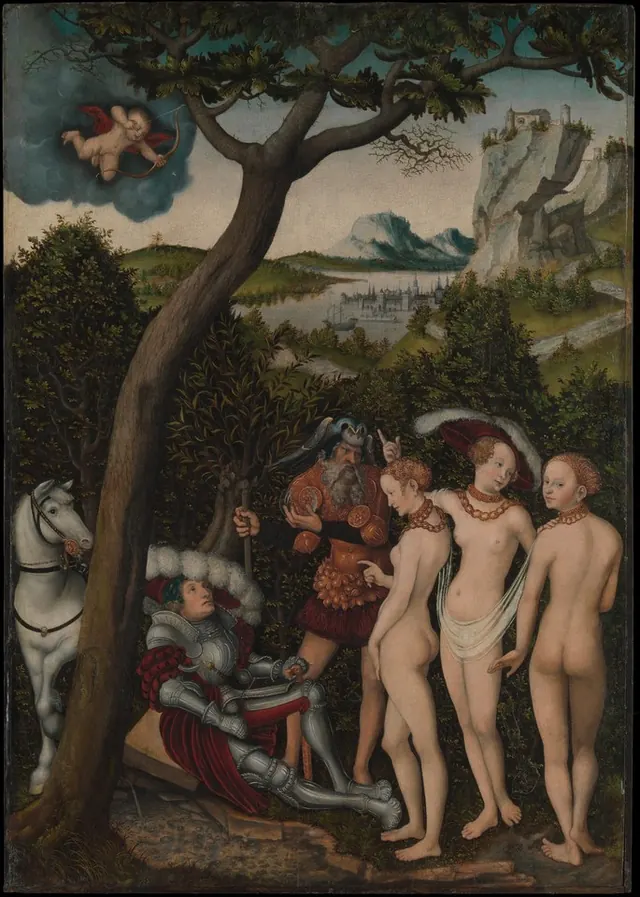
An ancient judgment of beauty enters the world of a sixteenth-century German court. Lucas Cranach the Elder dresses Paris in contemporary armor and gives the goddesses costly jewels. Around 1528, he was working for the Saxon electors in Wittenberg, where mythological scenes involving Venus appealed to courtly patrons.
Paris must choose the most beautiful of three goddesses, each offering a reward. Venus promises the love of Helen, wife of Menelaus of Sparta, and wins. In the myth, his choice leads to Helen’s abduction and the Trojan War. A viewer familiar with the story can therefore anticipate consequences beyond the peaceful woodland encounter.
Paris reclines beside a tree. Metal plates, straps, and gloves make him resemble a knight of Cranach’s own time. The costume brings the ancient subject closer to an audience familiar with courtly life. A saddled horse appears behind him.
Bearded Mercury stands between Paris and the goddesses. The mythical prize is a golden apple, but Cranach substitutes a transparent glass orb. Colors behind it remain visible through its surface. This small change turns a familiar attribute into an opportunity to paint reflection and transparency.
Minerva, Venus, and Juno stand before Paris. Different turns of their bodies combine nudity with necklaces and a headdress. The goddesses submit to a comparison conducted by a man. Courtly viewers could recognize their own culture of luxury in the accessories, even though the subject belongs to antiquity.
Cupid draws his bow above the clearing. In the museum’s reading, the arrow directed toward Venus anticipates Paris’s choice. The picture thus contains both the act of judgment and a sign of its outcome.
Towers rise on a distant cliff. Castle and woodland extend the myth’s relocation into northern Europe. Small transitions lead from nearby leaves to bluish distance. The figures gather tightly beside the large tree while deep space opens at the right. Stone towers and translucent distance extend the setting beyond the encounter.
The goddesses wear ornaments familiar to Cranach’s courtly audience, their bodies presented in different turns for comparison. The owner takes an observer’s place beside Paris. An ancient narrative accommodates nude figures within a costly private picture, while knowledge of the outcome adds a story of a choice that led to war.
- Medium
- Oil on beech
- Collection
- The Metropolitan Museum of Art
- Dimensions
- 101.9 × 71.1 cm
- Accession number
- 28.221
Sources
Image provided under CC0. Image licence