Lucas van Uffel (died 1637)
Anthony van Dyck · ca. 1622
Explore the painting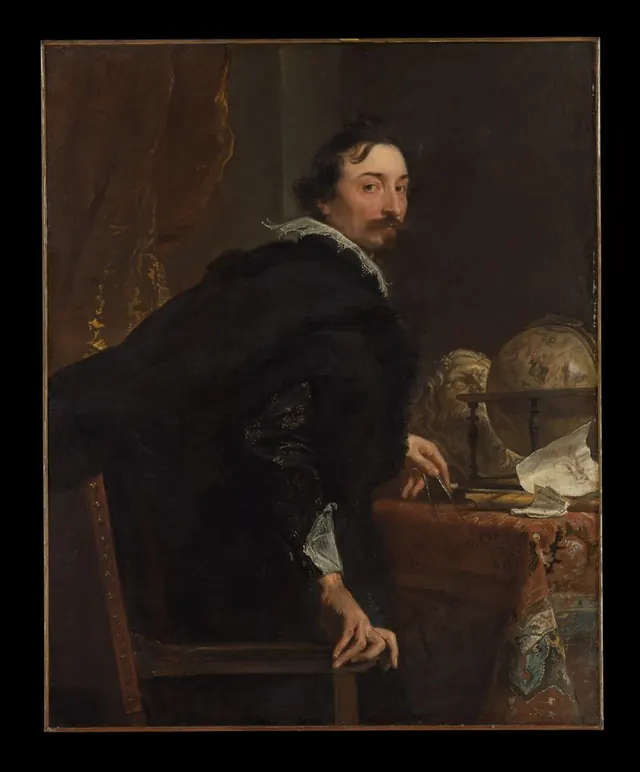
Lucas van Uffel was a wealthy Flemish merchant living in Venice. Van Dyck painted him around 1622 while studying Italian art. Instruments, a drawing, ancient sculpture, and a celestial globe replace merchandise and business correspondence beside the sitter. The portrait represents commercial prosperity through the image of a cultivated individual.
Van Uffel turns toward the viewer as though interrupted at an activity. The head’s rotation against the torso creates that impression. His pose gives the portrait action without a separate narrative. He appears responsive to another person while retaining the confidence of someone at home in his surroundings.
Drawing instruments occupy his hand. They associate the sitter with measurement, design, and precise knowledge. For a merchant, such objects could signify competence and contribute to self-presentation. The painting shows no transaction but preserves an impression of activity.
A celestial globe stands at the right, extending the sitter’s interests to the study of the heavens. Musical objects and works of art are assembled nearby. Education appears as a combination of sciences and artistic skills appropriate to elevated social standing.
An ancient head forms part of the small collection on the table. In Venice, engagement with antiquity belonged to a culture of collecting. Van Dyck, studying Venetian High Renaissance masters, uses this object to connect the sitter with an established artistic tradition. Possessing art becomes a visible sign of taste.
The patterned carpet and dark clothing differ in surface. The costume absorbs light while the carpet’s ornament breaks it up. Costly materials are not displayed as individual commodities. They create the everyday setting of someone whose prosperity appears already assured.
Trade supplied van Uffel’s opportunities, but the portrait asks that he be remembered through culture. That is a choice of public identity. The work shows wealth translated into social standing through education, collecting, and commissioning art. Knowing his profession changes the objects’ significance: they belong to someone shaping his position.
- Medium
- Oil on canvas
- Collection
- The Metropolitan Museum of Art
- Dimensions
- 124.5 × 100.6 cm
- Accession number
- 14.40.619
Sources
Image provided under CC0. Image licence