The Crucifixion; The Last Judgment
Jan van Eyck · ca. 1436–38
Explore the painting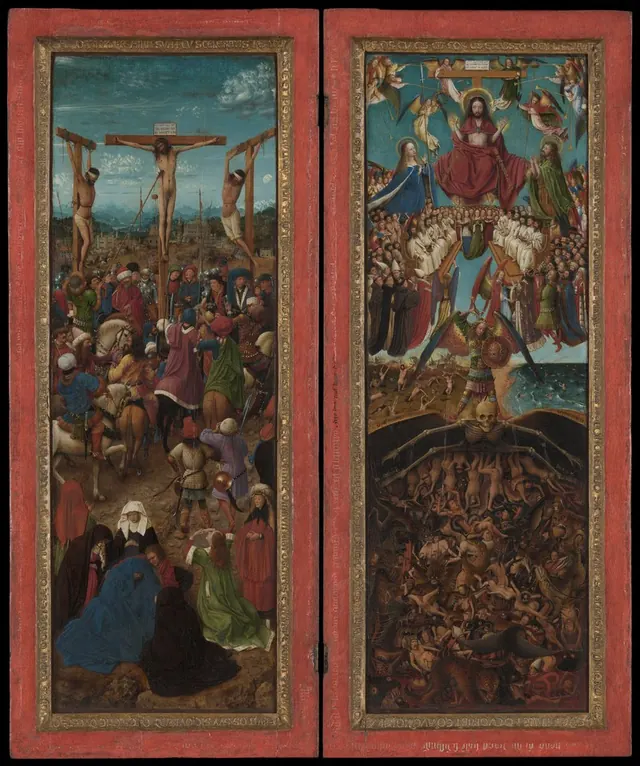
In two narrow panels, Jan van Eyck juxtaposed Christ’s death with the future judgment of humanity. The work dates to approximately 1436–38. Although displayed as a pair today, its original arrangement remains under investigation. The panels may have been triptych wings or doors to a small sacred enclosure. Their function involved close viewing. Each is only a little over half a meter high yet contains many figures, inscriptions, and successive spaces.
At the left, Christ hangs between two thieves. His cross rises above the crowd, with a city and distant mountains behind it. The execution belongs to an extensive, intricately constructed world. Van Eyck served the Burgundian duke Philip the Good and worked for demanding patrons who valued his skill. Here, painstaking oil painting makes sacred history visible through minute differences among people and objects.
Horsemen and witnesses on foot gather below the crosses. Rich dress and weapons distinguish their standing. People look in different directions, speak together, and watch the execution. Their numbers contrast sharply with the isolated crucified body above. A devotional viewer could recognize different responses to a single event within this crowd: involvement, curiosity, or indifference.
In the foreground, Mary in blue has collapsed among those close to her. Clothing almost conceals her figure. Bodily position and the support of others convey grief, while Christ’s exposed suffering appears above. The two areas connect death with its consequences for the living. Close viewing could move from the Crucifixion itself to those experiencing it as a personal loss.
In the right panel, Christ sits above the world as its judge. Apostles and the heavenly assembly are arranged beneath him. Stable ranks organize these figures very differently from the crowd at the execution. The one condemned by human authority now possesses supreme authority over everyone. The pairing develops a Christian understanding of history through the changed position of the same central figure.
Archangel Michael stands between heavenly order and the abyss. A vast skeleton of Death stretches below him, with human bodies seized by monsters farther down. Familiar supports and relations of scale disappear. Hell is a cramped place in which bodily integrity cannot be preserved. Its spectacle could provoke fear connected, in devotional use, with responsibility for one’s conduct.
The red frames carry part of the narrative. Conservators found Middle Dutch texts beneath a later coating, translating the Latin inscriptions on the inner frames. Latin was accessible to a priest; the vernacular widened the readership. Images worked together with words. Repainting gradually concealed that relationship until examination of the surface made it possible to recover it.
In a museum, the panels astonish through their abundance of detail. For their original audience, that detail participated in prayer, reading, and reflection on salvation. The Last Judgment placed a limit on earthly authority, yet its representation also directed conduct through promise and threat. The recovered inscriptions restore this active function. A beautiful object also served religious instruction and personal examination.
- Medium
- Oil on canvas, transferred from wood
- Collection
- The Metropolitan Museum of Art
- Dimensions
- 56.5 × 19.7 cm
- Accession number
- 33.92ab
Sources
Image provided under CC0. Image licence