View of Toledo
El Greco · ca. 1599–1600
Explore the painting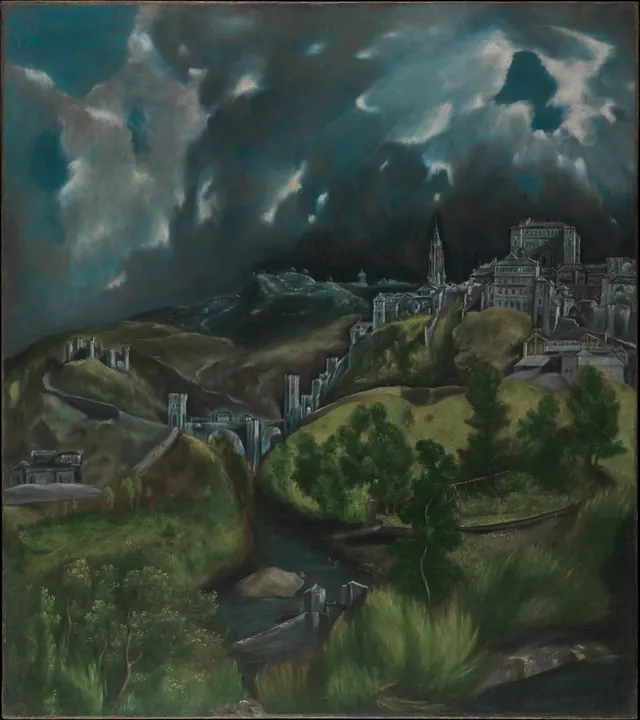
El Greco painted Toledo around 1599–1600. He spent most of his Spanish career in the city. Its skyline is recognizable, although buildings have been rearranged. He reconstructs the city to intensify its outline beneath a heavy sky. Fidelity to place and pictorial expression diverge at the level of architecture itself.
The cathedral’s narrow tower rises beside a dense cluster of houses. El Greco moved it in relation to other landmarks, placing its vertical against a pale opening in the sky. The alteration gives the skyline a sharper, more legible profile. A viewer familiar with Toledo encounters a recognizable city through a deliberately transformed view.
The large rectangular Alcázar anchors the city at the right. Its straight walls contrast with broken rooflines and hillsides. Pale façades appear almost flat, with windows gathered into dark rows. Masonry and ornament receive little attention. The buildings’ scale and outlines carry more force than small architectural particulars.
Below the city, a bridge joins the riverbanks. Its horizontal crosses the hills’ steep diagonals, offering a route from the foreground toward the buildings. Recession is uneven rather than gradual. Dark hollows adjoin pale strips, breaking depth into abrupt intervals.
Greens on the slopes appear almost luminous beside blackened patches of ground. Similar contrasts recur in the sky. Color distinguishes grass, water, and stone while also connecting distant parts of the picture: a bright slope below and a cloud above a tower can participate in the same visual movement.
Clouds occupy a broad area above the city. White edges curve around gray and blue masses divided by openings. Abrupt changes of light suggest an approaching storm. Similar combinations of darkness and brightness recur on the slopes, joining city and sky in a single charged landscape.
When Rainer Maria Rilke saw the painting in Paris in 1908, its extraordinary expressiveness struck him. A Spanish city view retained its force three centuries later and far from Toledo itself. El Greco preserves local landmarks, yet his clashes of color offer an experience requiring no knowledge of the city’s streets. Recognition and unease can operate independently.
- Medium
- Oil on canvas
- Collection
- The Metropolitan Museum of Art
- Dimensions
- 121.3 × 108.6 cm
- Accession number
- 29.100.6
Sources
Image provided under CC0. Image licence