Oedipus and the Sphinx
Gustave Moreau · 1864
Explore the painting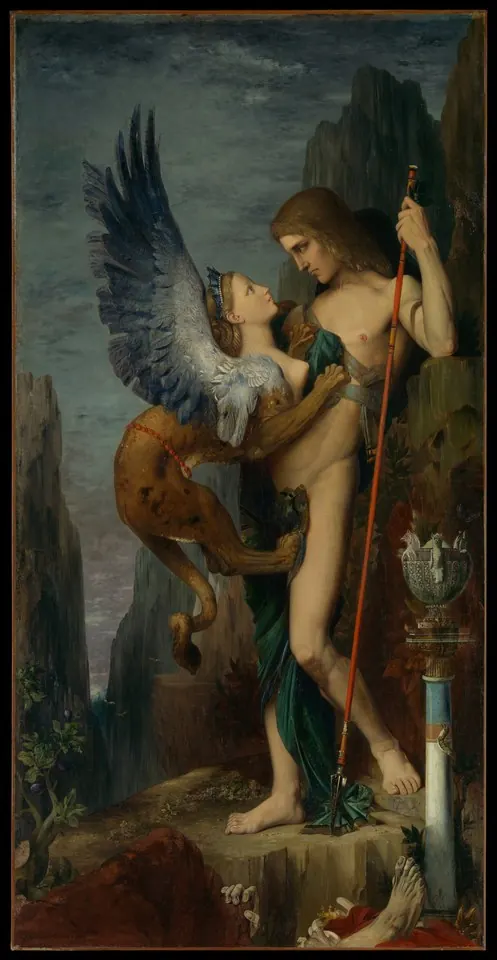
This confrontation established Moreau’s reputation at the Salon of 1864. Human remains show what happened to earlier victims of the Sphinx’s riddle. Such elaborately imagined mythological subjects later attracted Symbolist painters and writers.
Oedipus stands with a long staff. His upright figure remains stable before the creature clinging to him.
The woman-headed Sphinx clings to the hero. Close contact makes the riddle a physically tangible confrontation.
A large blue-grey wing rises on the left. It emphasises the creature’s composite, nonhuman nature.
A small vessel rests on a decorated column. Invented objects contribute to an elaborately constructed ancient setting.
Human remains lie at the rocky ledge’s foot. Previous victims reveal the consequences of answering the riddle unsuccessfully.
Dark rock encloses the figures from behind. The narrow setting concentrates attention on the hero’s encounter with the Sphinx.
Moreau prepared compositions through numerous studies. Even fantastic creatures could draw on observed animals. This painting’s recognition gave his imagined world a prominent place in official exhibition culture.
- Medium
- Oil on canvas
- Collection
- The Metropolitan Museum of Art
- Dimensions
- 206.4 × 104.8 cm
- Accession number
- 21.134.1
Sources
Image provided under CC0. Image licence