Juan de Pareja (ca. 1608–1670)
Diego Velázquez · 1650
Explore the painting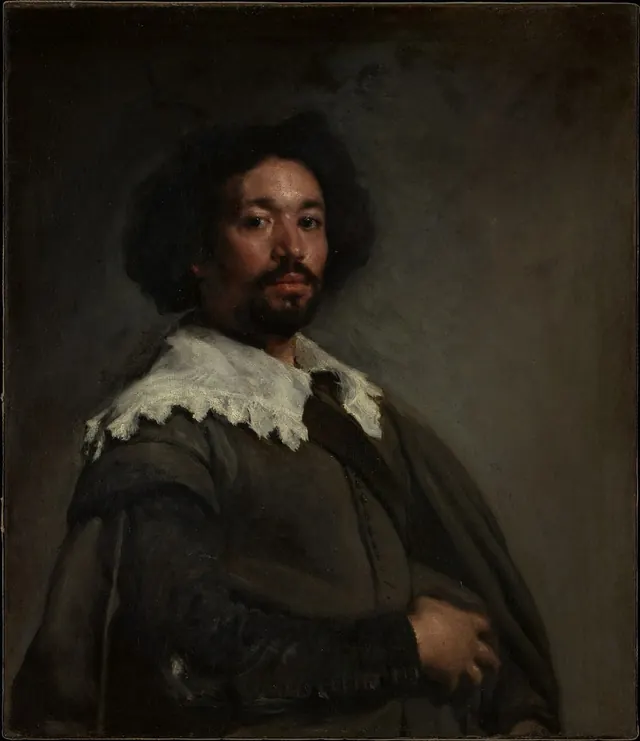
Velázquez painted Juan de Pareja in Rome in 1650. Pareja, a man of African descent born in southern Spain, had been enslaved by him for about two decades. The portrait presents him with assurance and no visible signs of subordination. The painter’s legal power over his sitter makes their encounter considerably more complex than an account of portraiture’s technical brilliance.
Pareja turns his head toward the viewer while his shoulders angle away. Light picks out forehead, cheekbone, and nose, leaving the other side darker. His eyes address the space beyond the canvas without an expansive gesture or smile. A small turn establishes a tangible, independent presence.
The white collar forms an uneven band of light around the face. Its edges are painted more freely than the sitter’s features. Separate touches convey fabric without describing every section equally. This difference allows the pale garment to emphasize the head while preserving a visibly active paint surface.
A hand appears near the cloak’s lower edge, holding no tool of work. The portrait does not explain Pareja through a task performed for Velázquez. Within the composition, he is released from a familiar assistant’s role, although actual freedom still required a separate legal decision.
Dark clothing occupies much of the canvas. Its broad mass gives little room to decorative objects or badges of office. Together with the body’s turn, it lends weight to the figure. The painter establishes significance through means that could equally serve a formal portrait of someone with a very different social position.
A neutral gray background remains behind Pareja. Neither workshop nor another person’s house defines his presence. The portrait won admiration in Rome, primarily strengthening Velázquez’s reputation. For Pareja, it provided an unusual public visibility that did not yet mean freedom to direct his own life.
A few months after painting the portrait, Velázquez signed a document granting Pareja freedom four years later, in 1654. Pareja subsequently worked independently in Madrid. His large religious paintings developed a brighter, more animated manner. He included a self-portrait in The Calling of Saint Matthew. A man known through another artist’s image left works of his own and determined his presence within them.
- Medium
- Oil on canvas
- Collection
- The Metropolitan Museum of Art
- Dimensions
- 81.3 × 69.9 cm
- Accession number
- 1971.86
Sources
Image provided under CC0. Image licence