"A King Offers to Make Amends to a Bereaved Mother", Folio from a Khamsa (Quintet) of Amir Khusrau Dihlavi
Attributed to Miskin · 1597–98
Explore the painting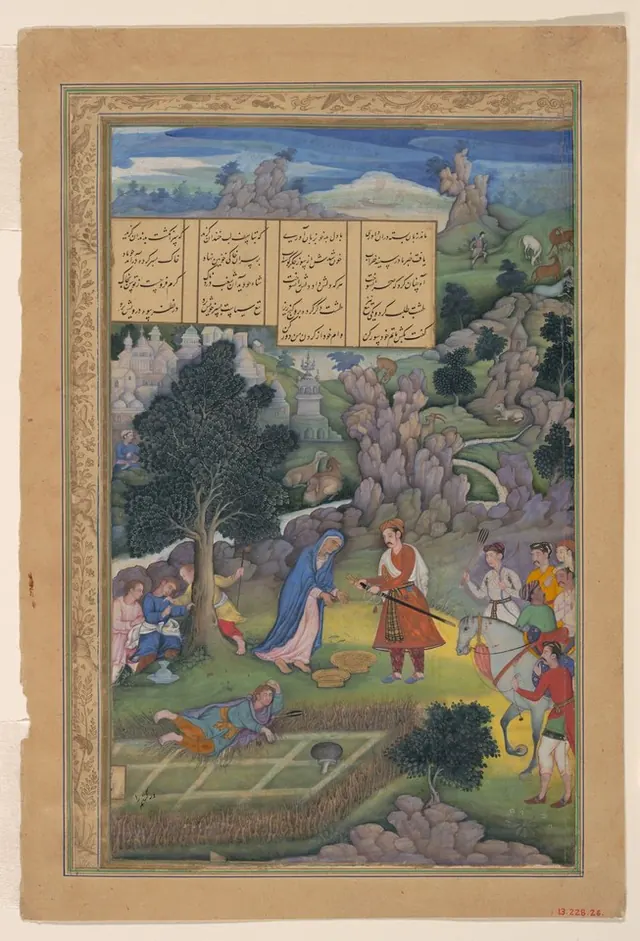
A ruler has accidentally killed a shepherd while hunting and must answer to the boy’s mother. He offers her a choice: cut off his head or accept gold. This 1597–98 folio from Amir Khusrau’s Khamsa is attributed to Miskin. In a court manuscript, a tale about a king tests the very right to command other people.
The ruler in orange stands before the woman. The sword belongs to his offer that the guilty party be punished. An emblem of military authority becomes an instrument that can turn against its owner. The story requires a king to acknowledge that rank does not remove responsibility for another person’s death.
The dead shepherd’s mother stands close to the ruler. In ordinary court hierarchy, an enormous distance would separate them. The tragedy makes her the person on whose decision the king’s fate depends. This temporary reversal of roles drives the miniature’s moral action.
Two gold dishes lie before the participants. One belongs to the compensation; the other is intended to receive the king’s head. The objects make the choice visible and terrible. Even generous payment stands beside an irreversible loss that no sum can undo.
The shepherd’s body lies below. It prevents the scene from becoming only a handsome gesture by a magnanimous monarch. The king’s offer exists because a person has died. The contrast between that body and the costly dishes sustains the story’s question about the price of justice.
Courtiers and horses appear at the right. They recall the hunt in which the death occurred and the ruler’s superior resources. The miniature combines Mughal figures with landscape devices from Persian painting. A costly courtly book discusses authority’s limits within the culture that serves it.
The king submits himself to the injured woman’s decision, yet he defines the available choices. The picture permits admiration for an accountable ruler and a question about whether the offered redress is adequate. The mother receives exceptional power after an irreparable loss. The story’s moral difficulty extends beyond the royal gesture.
- Medium
- Main support: Ink, opaque watercolor, gold on paper Margins: Gold on dyed paper
- Collection
- The Metropolitan Museum of Art
- Dimensions
- 24.8 × 15.9 cm
- Accession number
- 13.228.26
Sources
Image provided under CC0. Image licence