"A Muslim Pilgrim Learns a Lesson in Piety from a Brahman", Folio from a Khamsa (Quintet) of Amir Khusrau Dihlavi
Basawan · 1597–98
Explore the painting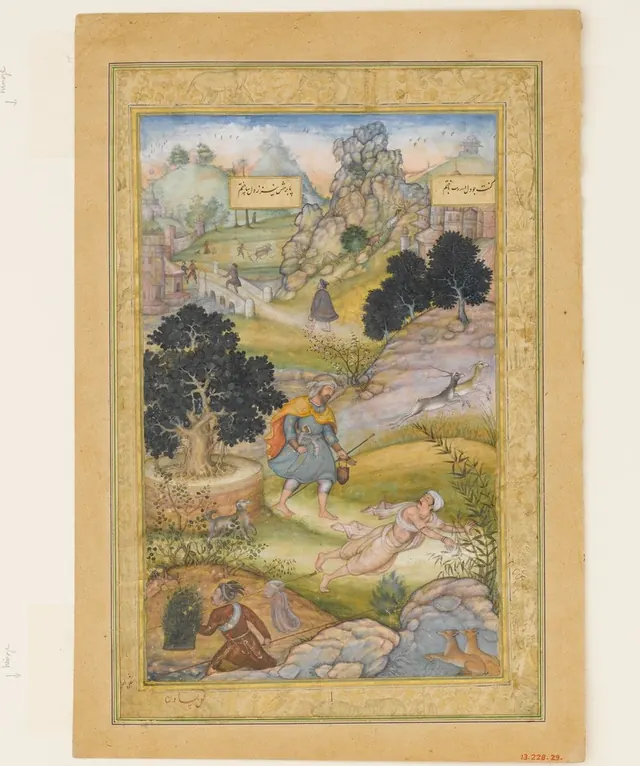
Two pilgrims meet on a road, bound for different holy places. A Muslim is traveling to Mecca, while a Brahman advances toward a Hindu temple by repeatedly prostrating himself full length. In Amir Khusrau’s story, this devotion moves the Muslim to remove his shoes and continue barefoot. The late-sixteenth-century painting is attributed to Basawan. It was made for a lavish Khamsa, a collection of five poems, owned by Emperor Akbar.
The Brahman lies on the ground before the standing traveler. His outstretched arms show how this method of movement works. The distance to the temple is measured by repeated prostrations demanding time and physical effort. The poem values voluntarily accepted hardship. The other pilgrim can respond to this devotion while continuing along his own religious path. Their encounter does not conclude with either man’s conversion.
The standing pilgrim is barefoot. His small story belongs to an extensive court commission. Akbar assembled a vast library, and several leading painters and the celebrated calligrapher Muhammad Husain Kashmiri worked on this manuscript. The costly book was made for a ruler governing people of different faiths. A story honoring another religion’s devotion therefore circulated within an imperial culture that selected and preserved such narratives.
Behind the travelers, the road rises toward distant buildings. Basawan divides depth into successive areas, changing the size of figures and the intensity of color. The catalogue Wonder of the Age connects this landscape with European models, reproducing an Antwerp engraving by Adriaen Collaert after Maarten de Vos alongside it. Printed sheets arriving from abroad offered court painters ways to study unfamiliar spatial arrangements.
At the lower left, a small figure carries a load. His task differs from the voluntary hardship undertaken by the poem’s protagonists. Their proximity supports another reading of the scene. Physical effort may be a vow before a deity or the everyday necessity of earning a livelihood and transporting goods. Both appear together in a richly decorated imperial book, although pilgrimage supplies its central moral example.
Deer occupy their own patch of ground among the rocks, apart from the human encounter. This inhabited landscape has prompted different readings. In Divine Pleasures, its surrounding beauty is interpreted as a gentle irony directed at protagonists detached from the external world. That reading preserves their devotion while placing two forms of spiritual attention side by side: concentration on a vow and receptiveness to surrounding life.
The miniature joins a Persian poem by an Indian author, painting from Akbar’s court, and European landscape devices. Manuscripts, prints, artists, and a patron’s library carried those connections. Surviving Khamsa illustrations are now divided between museums. In 2005 the Met temporarily reunited them with sheets from the Walters Art Museum, restoring the book’s context around separate images. The pilgrims’ encounter originally stood among stories of love, history, and moral choice.
- Medium
- Image: Ink, opaque watercolor, and gold on paper Margins: Gold on dyed paper
- Collection
- The Metropolitan Museum of Art
- Dimensions
- Overall, 25.1 cm
- Accession number
- 13.228.29
Sources
- The Metropolitan Museum of Art · "A Muslim Pilgrim Learns a Lesson in Piety from a Brahman", Folio from a Khamsa (Quintet) of Amir Khusrau Dihlavi
- The Metropolitan Museum of Art · Akbar’s Illustrated Khamsa
- The Metropolitan Museum of Art · Wonder of the Age, Basawan
- The Metropolitan Museum of Art · Divine Pleasures, Mughal Court Painting
Image provided under CC0. Image licence