"The Funeral of Isfandiyar," Folio from a Shahnama (Book of Kings)
Unidentified Iranian painters · 1330s
Explore the painting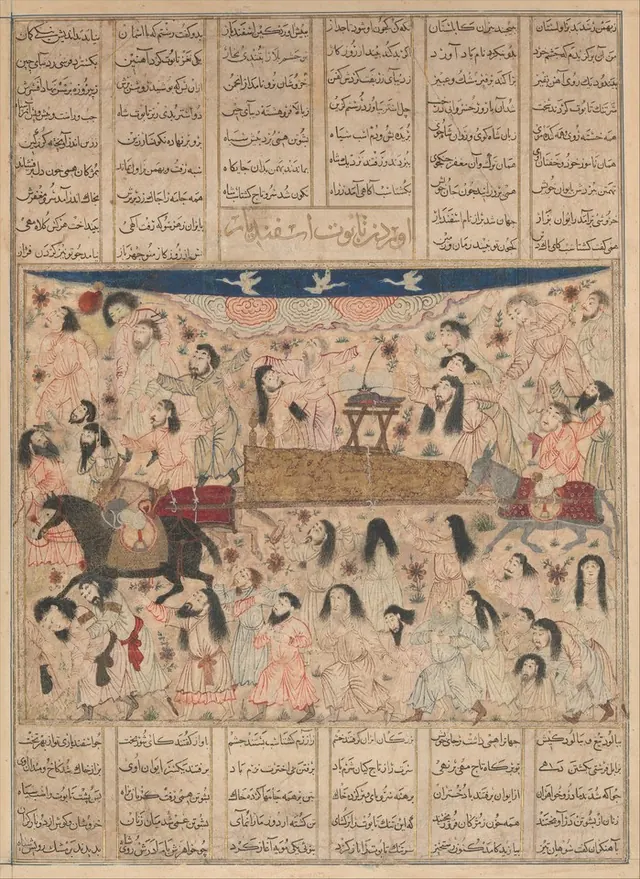
A bier moves among mourners. This is the funeral of Isfandiyar, a hero of Firdausi’s Persian Shahnama. The folio was painted in the 1330s for the manuscript known as the Great Mongol Shahnama. An ancient Iranian epic received a lavish form under the Ilkhanids, rulers of Mongol origin. The painter chose collective mourning rather than another heroic exploit.
A golden covering conceals the body on the bier. Its long horizontal shape crosses much of the crowd. The hero occupies the center, yet his face is hidden. The event is expressed through the actions of those who remain alive, shifting attention from the dead man’s appearance to the community’s response.
People raise their arms and pull at loose hair, which the museum identifies as a sign of mourning. Fingers, elbows, and strands make the gestures legible despite the restrained washes of color.
Within the group at the right, some figures tilt their heads back while others bend forward. The painter varies their gestures. Red and gray-blue lines follow the clothing, with darker marks defining faces. The museum compares this linear handling and light washes with contemporary Chinese painting.
A blue band above the procession contains white birds and curling clouds. Their flowing outlines differ from the mourners’ angular gestures. Ilkhanid art combined Persian and East Asian practices. The illustration therefore records artistic connections in its own period as well as presenting the remote past of its heroes.
Verse surrounds the image above and below. The manuscript is now dispersed among collections. In the early twentieth century, dealer Georges Demotte dismantled it and split some double-sided folios for sale. The museum notes that some images consequently acquired replacement or incomplete text. Their present arrangement cannot automatically be assumed intact.
At the Mongol court, the Persian epic became part of prestigious courtly culture. Centuries later, dealers extracted individual pictures from the costly book. The object of value shifted from a complete manuscript to a marketable image. Isfandiyar’s mourning survived, but its place in the sequential reading of the epic was disrupted.
- Medium
- Ink, opaque watercolor, and gold on paper
- Collection
- The Metropolitan Museum of Art
- Dimensions
- Page, 58 cm
- Accession number
- 33.70
Sources
Image provided under CC0. Image licence