Tughra (Insignia) of Sultan Süleiman the Magnificent (r. 1520–66)
Unidentified Ottoman calligrapher and illuminator · ca. 1555–60
Explore the painting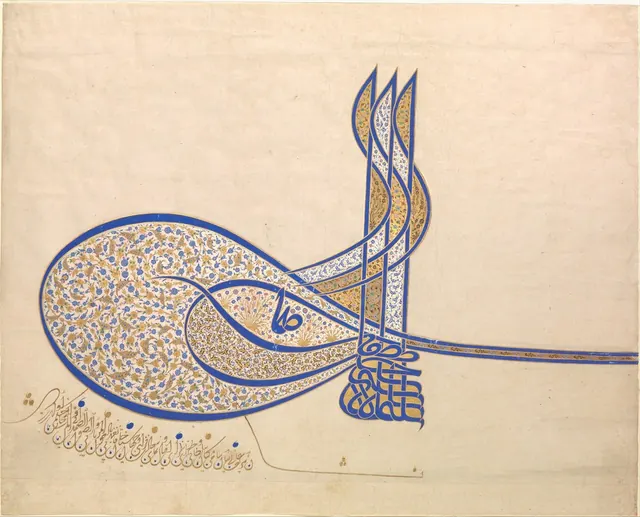
This design was an emblem of state authority. Tughras appeared on sultanic decrees, letters, endowment documents, and coins. Its interwoven lines contain Süleiman’s name, that of his father Selim, and a formula of perpetual victory. The image dates to about 1555–1560, within the final decade of Süleiman’s long reign.
Blue letters cluster in the lower section. To an untrained viewer they are almost inseparable. This complexity belonged to the design itself. A designated court specialist drew the tughra, reproducing an established form in the ruler’s name.
Three tall strokes form the upper silhouette, with curved lines passing between them. From a distance they remain recognisable even when the small flowers merge. These are two distinct scales of work: the overall outline identifies sultanic authority, while close looking reveals the workmanship of an individual document.
Delicate flowering stems fill the large loop on the left. Some petals are blue, others red, while leaves are painted in gold. The plants occupy the available spaces within the loop. A court illuminator embellished an existing calligraphic structure and had to fit the small designs to its curves.
The pattern changes within the inner loop, where dark scrolls stand out against gold. Adjacent areas receive different treatments although they belong to the same system of lines. A strong blue boundary keeps their tiny elements from merging into a single mottled surface.
Long parallel lines extend almost to the right edge of the sheet, leaving a broad area of paper beside them. This makes the dense decoration at the left and below particularly conspicuous. Long clear directions remain available for following the letters’ large-scale design.
Lines of smaller writing appear below the main emblem. An ordinary sequence of words shares the sheet with the ceremonially elaborate form of a name. They call for different kinds of reading. Calligraphy connects the document’s text with its official presentation.
Someone could recognise the sultan’s emblem without being able to decipher its words. Another viewer might judge the illumination and precision of the calligraphy. This difference invites discussion of how an image of authority worked: through a document’s content, an established emblem, or precious decoration? The answer also depended on its recipient.
The calligrapher and illuminator of this leaf have not been identified. The division of their work is nevertheless known from court practice. One specialist drew the official emblem; another could add painted decoration. State administration here employed skills now commonly associated with manuscript illumination and decorative painting.
- Medium
- Ink, opaque watercolor, and gold on paper
- Collection
- The Metropolitan Museum of Art
- Dimensions
- 63.5 × 76.2 cm
- Accession number
- 38.149.1
Sources
Image provided under CC0. Image licence