"Akbar With Lion and Calf", Folio from the Shah Jahan Album
Govardhan · verso: ca. 1630; recto: ca. 1530–50
Explore the painting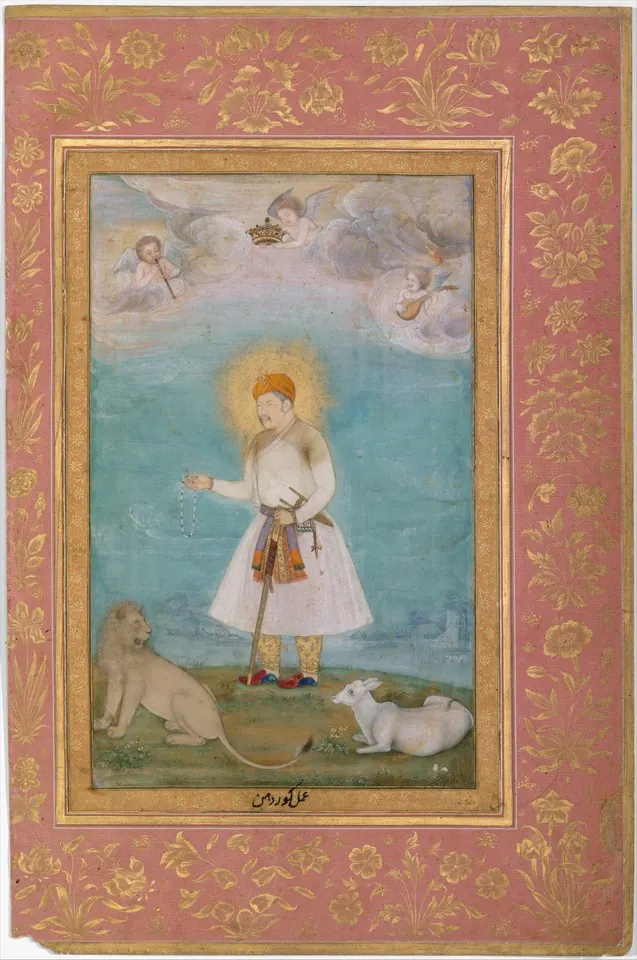
Akbar died in 1605; Govardhan painted this portrait around 1630. It represents a ruler remembered under his descendants. A lion and calf remain together at the emperor’s feet, suggesting the beneficial order established by his authority. The museum traces the motif to Elizabethan English models. At the Mughal court, a borrowed image became a means of honoring a dynastic ancestor.
Akbar’s face appears in profile within a pale halo. His large central figure governs the placement of the others. A posthumous image assembles signs of ideal rule around a recognizable person. Likeness attaches a general political virtue to a particular emperor’s name.
The lion at the left retains visible teeth. The painter preserves its physical capacity to attack within an apparently peaceful arrangement. The powerful animal must remain powerful for coexistence with the calf to matter. The allegory depends on an inequality that continues to exist. Authority capable of restraining a predator promises safety to the weaker creature.
The calf turns its head toward the lion. The museum reads its sideways glance and lowered ears as timid apprehension. This interpretation complicates the ceremonial idea of peace. The powerful animal’s calm and the weaker creature’s safety may appear differently to each participant. Beside the promise of well-being, Govardhan preserves the vulnerability of the one needing protection.
Small winged figures hover above the emperor. They come from European art, as do aspects of the distant landscape. Court artists used images crossing linguistic and religious boundaries. Here the angels affirm Akbar’s exceptional dignity. The international origins of individual details expand the means by which a local dynasty describes its authority.
Prayer beads appear in Akbar’s hand and weapons at his waist. Piety and force are presented as compatible royal qualities. The sheet belonged to the Shah Jahan Album, where rulers’ images accompanied nature studies and specimens of calligraphy. Earlier writing by Mir Ali Haravi occupies the other side. Dynastic memory thus took its place among works the court considered worthy of preservation and close study.
The portrait turns a past reign into a foundation for inherited prestige. Its ideal world is organized around one person, though the actual empire depended on many groups and relationships. The calf allows that promise to be considered from the protected creature’s position. How secure is peace when the capacity for violence remains close at hand? The question arises within the allegory itself, where the lion’s teeth remain visible.
- Medium
- Ink, opaque watercolor, and gold on paper
- Collection
- The Metropolitan Museum of Art
- Dimensions
- 38.9 × 25.7 cm
- Accession number
- 55.121.10.22
Sources
Image provided under CC0. Image licence