"Tahmuras Defeats the Divs", Folio 23v from the Shahnama (Book of Kings) of Shah Tahmasp
Attributed to Painting attributed to Sultan Muhammad · ca. 1525
Explore the painting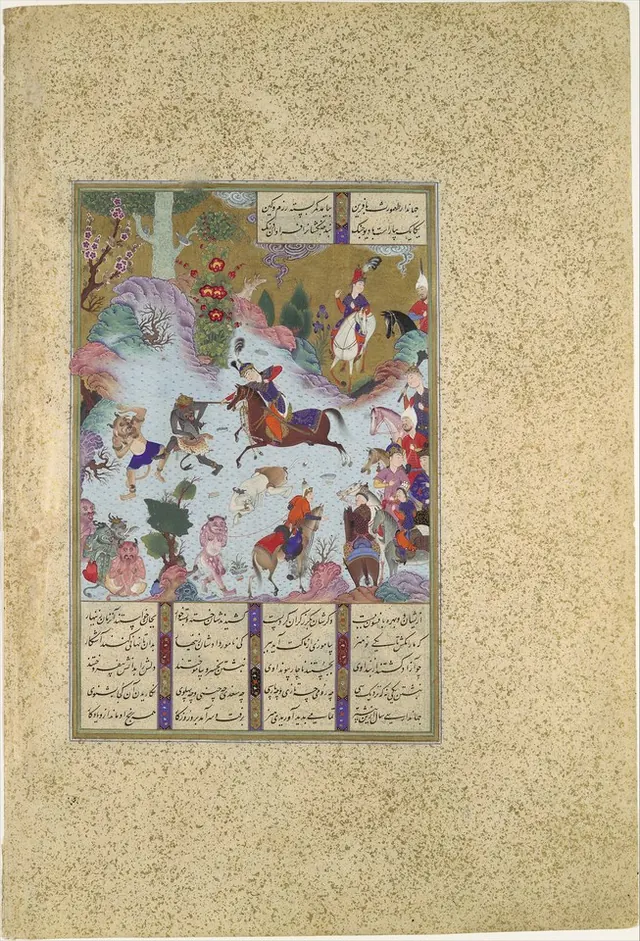
King Tahmuras has defeated the divs, but the battle has an unexpected sequel. In exchange for their lives, the defeated demons will teach humanity to write. This miniature from Shah Tahmasp’s Shahnama presents a military victory that will lead to the transmission of knowledge. It is attributed to Sultan Muhammad, a leading master in the manuscript’s workshop, and dates to about 1525.
At the center, Tahmuras raises his weapon from horseback. An open patch of the golden ground separates him from the crowded group below. The lifted arm’s diagonal continues through the horse’s movement. Victory takes a visible form in the mounted ruler’s advantage over creatures retreating or already brought to the ground.
The divs have different faces, horns, and spotted bodies. One recoils, another turns its head, and another is hemmed in by its neighbors. Sultan Muhammad is known for such grotesque figures. Their varied gestures make the adversaries memorable. Clothing and equipment give the royal forces a more ordered appearance, while differences between the demons’ individual bodies are accentuated.
A pink div below is led on a rope. Combat has given way to captivity. Sparing the captives makes the poem’s bargain possible. No instruction in writing is shown yet. The painter selects a moment when the unequal positions of the two sides are conspicuous, while the victors’ future reliance on another people’s knowledge remains beyond the depicted event.
Figures in elaborate dress stand at the right, their stillness contrasting with the congested fighting. An ordered royal entourage gathers at the edge of the battle. In a court manuscript, Iran’s past addressed questions of present authority. Ancient kings supplied a ruler with examples of decisions and their consequences.
Verses occupy small rectangular compartments above the image. The painting has its own space, but reading connects it to the story’s continuation. There is a striking correspondence here. A book requiring accomplished calligraphy and costly materials recounts how people acquired writing itself from defeated beings.
Tahmuras remains the victor, yet the divs possess something he lacks. The story can be read both as a celebration of royal force and as recognition of a debt to another culture. These meanings coexist. The battle establishes who dictates the bargain; its sequel explains why military superiority alone cannot create human society.
- Medium
- Opaque watercolor, ink, silver, and gold on paper
- Collection
- The Metropolitan Museum of Art
- Dimensions
- 55.9 × 40.6 cm
- Accession number
- 1970.301.3
Sources
Image provided under CC0. Image licence