White Plum Blossoms and Moon
Itō Jakuchū · 1755
Explore the painting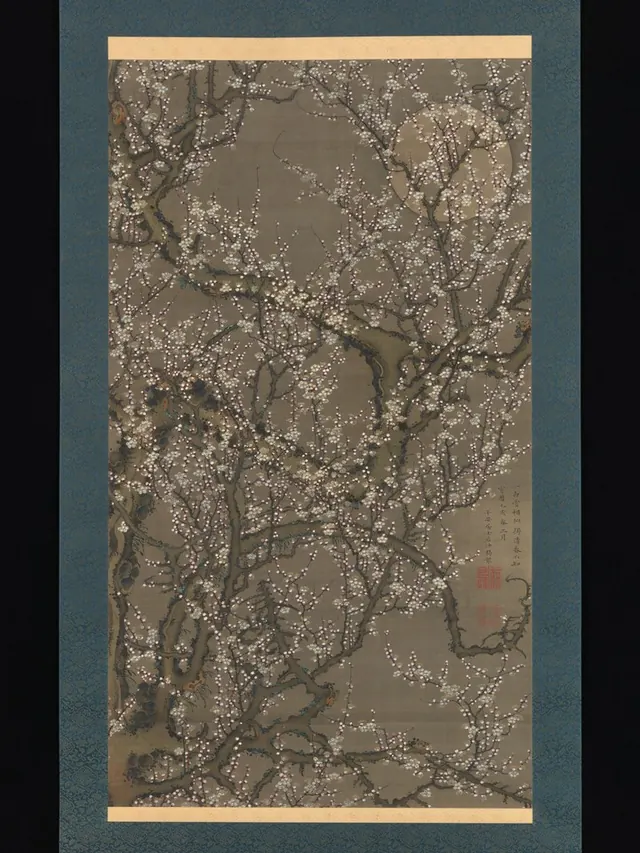
Jakuchū devoted a large hanging scroll to this plum tree in 1755, at a turning point in his life. The eldest son of a Kyoto wholesale grocer, he had managed the inherited business for more than fifteen years. Only toward forty did painting become his principal occupation. This is among his earliest dated works. Behind the painstaking image lies the experience of someone who had long been responsible for a very different kind of work.
The trunk enters from below and twists leftward. Dark fissures, projections, and knots are rendered separately. Jakuchū chooses an old tree with an intricate form, requiring us to follow growth through turns and forks. Against the largely unpainted silk, each branching becomes particularly clear. The structure of the wood conveys the plant’s age, while new flowers have opened beside it.
White flowers densely cover slender branches. Up close, individual petals and tiny dark centers can be distinguished. From farther away, the same blossoms form a pale pattern. The scroll provides two viewing distances. Near at hand it invites botanical attention; across a room, the distribution of white and the branches’ dark design become more prominent. Detail remains part of a decorative whole.
A pale moon appears behind the upper branches. Its even edge differs from the tree’s irregular contours. Jakuchū leaves the surroundings open. Tree and moon occupy the scene, while the pale silk connects openings between blossoms with the sky.
Small blue-green patches on the bark enliven the restrained palette. Color appears in several places among brown and black. Jakuchū builds the image from many such small distinctions. His later reputation rests in large part on colored paintings of birds and plants, in which individual feathers, leaves, and blossoms likewise form a closely organized surface.
The signature and seals at the right belong to the world of professional painting. Jakuchū’s subsequent work was closely connected with the Buddhist monastery Shōkoku-ji. In 1765 he donated a Shakyamuni triad and scrolls from Colorful Realm of Living Beings to it. This earlier plum painting does not belong to that series. The later pairing of natural imagery with the Buddha nevertheless shows the place that observing living things could occupy in his religious life.
Jakuchū is often called one of eighteenth-century Kyoto’s eccentric painters. Yet this scroll’s history also involves the city’s established institutions: family commerce, artistic practice, and the monastery. Leaving business opened time for painting, while the monastery preserved his scrolls and used them in religious life. The flowering plum stands near the beginning of that path, as a former family-business manager developed a pictorial language of his own.
- Medium
- Hanging scroll; ink and color on silk
- Collection
- The Metropolitan Museum of Art
- Dimensions
- Image, 140.7 × 79.4 cm
- Accession number
- 2015.300.213
Sources
Image provided under CC0. Image licence