The Virgin of Guadalupe with the Four Apparitions
Nicolás Enríquez · 1773
Explore the painting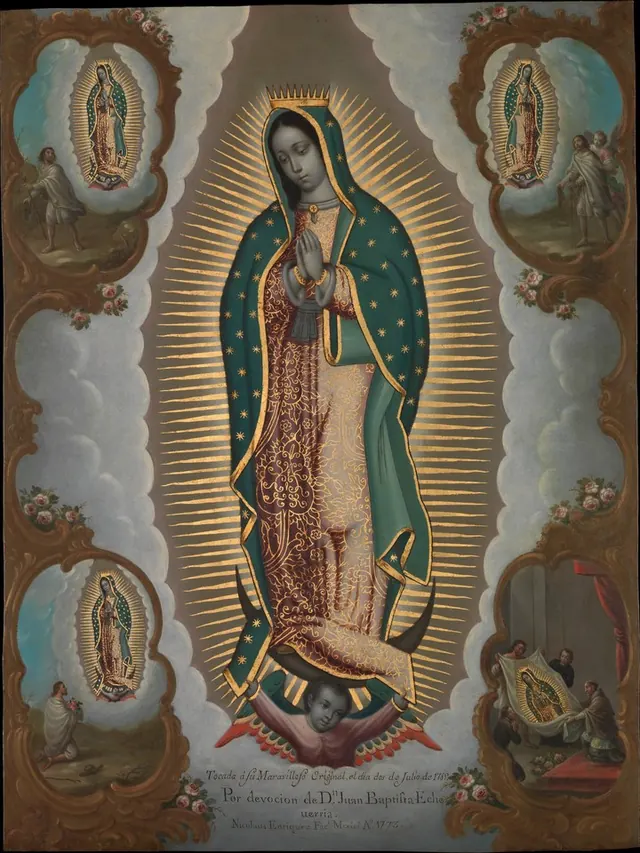
Nicolás Enríquez repeated the venerated image of the Virgin of Guadalupe at the centre and placed an account of its origin in the corners. He painted the work in Mexico in 1773, when this image held a prominent place in the religious life of New Spain. Copies allowed worshippers to address the sacred image far from its original location.
In the upper-left episode the Virgin appears to Juan Diego at Tepeyac, near Mexico City. This begins a sequence the museum identifies as three apparitions followed by the revelation of the image on a cloak. These events belong to religious tradition; the painting presents them as the basis for venerating the central image.
The upper-right episode shows another meeting with the Virgin. The repeated figure marks a new event in the story. An eighteenth-century viewer could recognise familiar episodes and then return to the large central image. The small scenes explain why this particular appearance is regarded as sacred.
At the lower left Juan Diego holds flowers. Unlike the still central figure, the small scenes contain bending bodies, extended hands, and changing settings. A single copper panel combines an image for prayer with a sequence that can be followed as a narrative.
At the lower right men examine an unfolded cloth bearing the Virgin’s image. This is the tradition’s culmination: the image appears on Juan Diego’s cloak. A painted copy thus contains the story of its prototype’s miraculous creation, a particularly significant episode for a work intended to reproduce a sacred image.
Long gold rays surround the central figure. Stars appear on the dark mantle and fine floral ornament on the dress. Gold also recurs in the frames of the corner scenes. The formal sacred image and small narratives share a decorative system despite their different scales.
The inscription below records the copy’s contact with the original. For its owner, significance lay both in resemblance and in sanctification through direct contact. The inscription stresses a relationship between two particular objects that accuracy of copying alone could not replace.
This copy had religious value in its own right. In a museum it also records Enríquez’s skill and practices of devotion in colonial Mexico. These ways of encountering it differ. A modern viewer attending to ornament and composition can overlook what mattered most to its original owner: the connection between this particular object and a sacred prototype.
- Medium
- Oil on copper
- Collection
- The Metropolitan Museum of Art
- Dimensions
- 56.5 × 41.9 cm
- Accession number
- 2014.173
Sources
Image provided under CC0. Image licence