Self-Portrait
Paul Gauguin · 1889
Explore the painting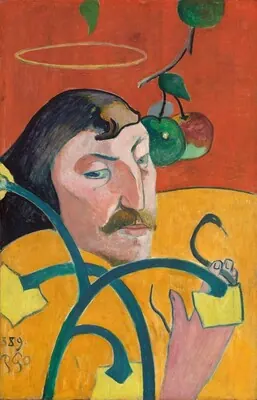
Gauguin painted this self-portrait on a cupboard door in a Le Pouldu inn. A halo, apples, and serpent combine signs of sanctity and temptation. The image constructs an exceptional role for the artist. Its caricatural face and disembodied hand make the self-presentation deliberately provocative.
The head tilts and the eyes look downward. The face exists almost apart from the body against broad red and yellow fields.
A thin halo floats above his head. Gauguin assigns himself a sign usually associated with saints.
Two red-and-green apples hang from a branch. In the museum's interpretation, they refer to the forbidden fruit and the Fall.
A green curling form rises beside the fingers. It becomes a serpent held beside the artist's own image.
A thin green boundary divides red and yellow fields. Broad color relationships organize the ground rather than a depicted room.
The door came from Marie Henry's inn dining room. Gauguin left the work with the landlady in place of rent. The provocative self-image thus had a specific domestic history before becoming an independent museum object.
- Medium
- oil on wood
- Collection
- National Gallery of Art, Washington
- Dimensions
- Overall, 79.2 × 51.3 cm
- Accession number
- 1963.10.150
Sources
Reproduction of a public-domain artwork. Image licence