A Sunday on La Grande Jatte
Georges Seurat · 1884–1886; border 1888–1889
Explore the painting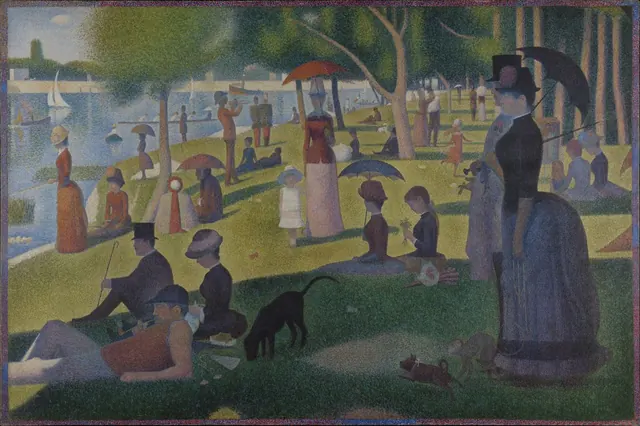
Seurat developed this leisure scene in 1884–86 through many preparatory studies. The people on La Grande Jatte appear almost motionless. Their placement and colour relationships are carefully planned around an ordinary Sunday outing.
Small dots of different colours appear in the foliage. Seurat places them side by side, relying on visual blending at a distance. This technique, pointillism, belongs to his exploration of colour perception.
The couple on the right is much larger than the figures beyond. Profiles are sharply defined and poses are stable. Seurat aimed to make a scene of modern life equivalent to a classical Greek frieze, a long band of figures. This helps explain its unusual order.
A child in a pale dress faces almost directly towards us. Most neighbours appear in profile or from behind. The turn of the body and light colour distinguish this small figure among the adults.
The woman on the right holds a monkey on a leash, recognisable by its curled tail. This unusual detail has prompted differing interpretations, but cannot securely establish the woman’s social position.
Shadows lie across the grass in large dark areas with clear edges. Small coloured dots remain visible inside them. The same technique operates in sunlight and shadow, while the combinations of neighbouring colours change.
Boats and small pale sails appear on the river, separated by stretches of water. The open view on the left differs from the crowded right side and establishes the breadth of the gathering place.
The band of coloured dots along the edge is painted on the canvas. Seurat added it in 1888–89, relating its colours to adjacent parts of the scene and extending his experiments with colour contrast beyond the main image.
Seurat exhibited the painting at the final Impressionist exhibition in 1886. Small separate strokes and prolonged work from studies distinguished his method from rapid outdoor painting. The critic Félix Fénéon called the approach Neo-Impressionism.
- Medium
- Oil on canvas
- Collection
- Art Institute of Chicago
- Accession number
- 1926.224
Sources
Public-domain faithful reproduction under Wikimedia Commons PD-Art assessment. Image licence