Saturn
Francisco Goya · 1820–1823
Explore the painting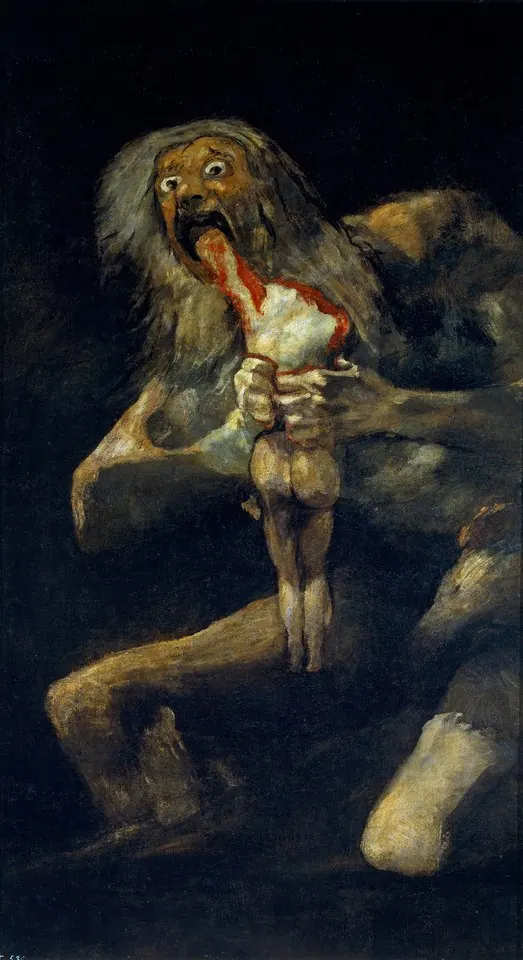
Goya painted this scene on a wall of his house near Madrid, purchased in 1819. It belonged to fourteen murals later called the Black Paintings, made for domestic rooms without an established public commission. A huge figure devours a smaller human body. The traditional title identifies him with Saturn, who in myth consumed his children for fear of losing power.
White eyes stand out sharply in the dark face. Their uneven placement and the open mouth create an intense expression with relatively little paint. Loose grey bands describe the hair, while part of the head disappears into darkness. Goya retains the features that make the action disturbingly close. An elaborate mythological setting is unnecessary for understanding the violence itself.
The pale body is already mutilated, and red paint around its wounds stands out against ochre and grey. The victim’s proportions are difficult to reconcile with the familiar myth of swallowed infants. This is one reason to handle the title’s literal implications carefully. The image can be connected with the myth, but its bodily specificity resists becoming a settled illustration of a familiar story.
The fingers grip the torso so tightly that the larger figure’s hands almost encircle it. The difference in scale makes unequal force visible. This grasp allows a reading of power destroying what it tries to possess. The action supports that possibility. Identifying the figure as a particular king or the victim as a specific people would require further evidence.
Bent legs barely fit within the narrow field. The left knee projects, while a lit area on the right emerges from near-black paint. The whole bodily position is difficult to reconstruct. Goya brings parts close and conceals their connections. The figure feels cramped and large even though the surrounding space cannot be established.
No horizon, architecture or objects appear behind the figure. In a museum, the darkness can seem a self-contained background, but other murals originally stood nearby in the room. Their proximity could change the scene’s effect. Treating Saturn as an independent canvas is convenient, yet that condition resulted from transferring the wall painting, rather than its original design.
In the 1870s, Salvador Martínez-Cubells transferred the murals to canvas. Documents and photographs by Jean Laurent help reconstruct their former arrangement. Modern viewers therefore encounter a work that underwent substantial material change. The surviving surface supports close study of Goya’s painting while leaving questions about losses, original surroundings and titles supplied by the artist.
Goya’s age, illness and experience of political upheaval offer context but no single key. Personal fear, a myth of power and a broader image of destruction are different possible readings. None should be presented as the artist’s recorded explanation. The painting’s action remains extremely clear while its final meaning stays open.
- Medium
- Mixed technique; mural transferred to canvas
- Collection
- Museo Nacional del Prado, Madrid
- Dimensions
- 143.5 × 81.4 cm
- Accession number
- P000763
Sources
Reproduction of a public-domain artwork. Image licence