The Birth of Venus
Sandro Botticelli · c. 1485
Explore the painting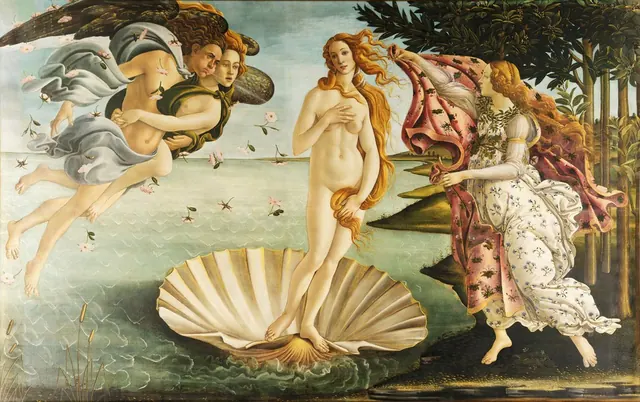
In fifteenth-century Florence, wealth from trade and banking funded buildings, paintings and the study of ancient books. The Medici supported artists, poets and philosophers. This was the setting for a large painting of a nude pagan goddess. Understanding Venus means looking at how an ancient myth entered the life of a Christian city.
Botticelli had already painted devotional pictures and altarpieces for Florentine patrons. In 1481 the pope summoned him to paint the walls of the Sistine Chapel. Back in Florence, he produced his major mythological pictures. His workshop served both religious and secular patrons, while an interest in antiquity supplied new subjects and models for the human figure.
The commission is associated with the Medici, although the patron is unknown. In 1550 Vasari recorded the painting at their Villa of Castello.
The shell carries Venus towards Cyprus. Zephyr blows her ashore from the left; his companion is sometimes identified as Aura. A Hora of spring or one of the Graces welcomes her on the right.
Venus covers herself with a hand and her hair, following an ancient sculptural pose. Parts of her hair are gilded.
Venus’s hair streams rightwards, echoing the folds of the open cloak. On the left, pale fabric curls around the flying pair. These lines make the movement of air visible. Returning to Venus’s face, we can see how restrained her pose is amid all the flowing hair and cloth.
Two hands hold the edges of the cloak: one beside Venus’s hair, the other opening the fabric below. The pink cloth already surrounds part of the figure, making the next movement easy to imagine. Botticelli has chosen the moment before the attendant wraps the arriving goddess in her cloak.
Venus’s feet barely rest on the shell’s edge while her body leans away from its support. Her long neck and lowered shoulder continue the figure’s curve. It would be a difficult pose to hold in life. In the painting, a continuous outline connects it, leading from her head down to her toes.
Trees crowd behind the woman on shore, while the sea to the left remains almost empty. Botticelli leaves a pale area around Venus between them. Small waves, leaves, flowers on the dress and strands of hair are clearly outlined. Repeated small forms bring the large surface together, keeping the drawing legible even at a distance.
Ancient gods also gave Florentines a way to think about faith. Under Medici patronage, the philosopher Marsilio Ficino explored connections between ancient teachings and Christianity. The Uffizi’s present interpretation relates the resemblance between Venus and Botticelli’s Madonnas to this idea: a pagan image could express spiritual beauty. This is a historical reading of the painting; we have no written explanation from the artist himself.
Another reading concerns social prestige. A large mythological painting in a private home could display its owner’s learning and connections with artists and philosophers. Patronage gives a painter the means to work, while the commission also represents the owner’s world. Venus allows both sides of that relationship to be considered, although the precise terms of its commission are unknown.
Venus’s face is often associated with Simonetta Vespucci, a celebrated Florentine beauty whose family lived near Botticelli’s workshop. Yet a recognisable ideal of a woman’s face appears throughout his work, and the identification remains a hypothesis. Nor can the goddess’s expression establish a real woman’s emotions or the history of her relationship with Botticelli.
Venus’s present fame took centuries to develop. After a long decline in interest, Botticelli was rediscovered in the nineteenth century. The image later travelled far beyond the museum. In 1984 Andy Warhol transformed her face and hair into vividly coloured images. Her outline, hair and gesture remain recognisable even in a different medium and an entirely new palette.
- Medium
- Tempera on canvas
- Collection
- Uffizi Galleries, Florence
- Dimensions
- 172.5 × 278.5 cm
- Accession number
- 1890 n. 878
Sources
Reproduction of a public-domain artwork. Image licence