Luncheon on the Grass
Édouard Manet · 1863
Explore the painting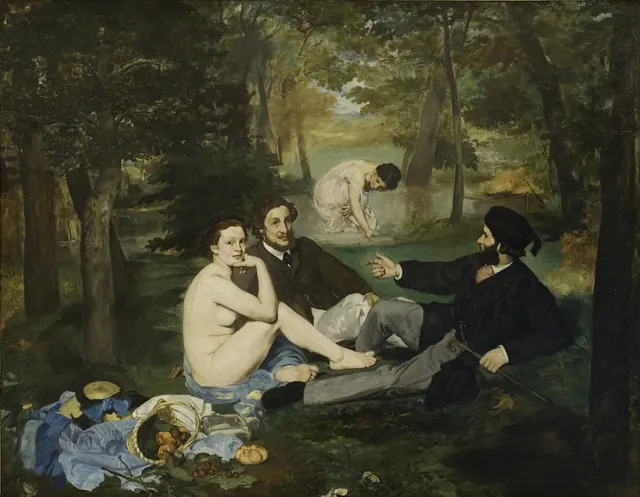
In 1863 the Paris Salon rejected this large painting by Manet. It appeared at the Salon des Refusés under the title The Bath. A nude woman beside clothed contemporaries provoked outrage. Nudity had long belonged to art, but here no goddess’s name or ancient story explained it. Viewers encountered a modern gathering constructed through respected historical models.
The woman looks directly at us with her chin supported by one hand. Her pale body fills the foreground, sharply separated from the dark greenery. Her gaze places the viewer within an awkward situation. We are not simply observing a group from a distance. Our presence seems already noticed, although nobody explains why one person is undressed while others remain in city clothes.
The men sit nearby in contemporary dress. A pale shirt, tie and dark jacket belong to the nineteenth-century viewer’s world. Their proximity to a nude figure disrupts a comfortable distance between museum beauty and actual life. Yet the subject recalls Titian’s Pastoral Concert, which also places clothed men beside naked women. Manet argues with tradition through its own images.
The man at right extends a hand towards his companions. The group’s construction relates to Marcantonio Raimondi’s engraving after Raphael’s Judgement of Paris. Poses respected in an ancient subject move into a modern picnic. This tests artistic conventions: if the underlying arrangement remains authoritative, why does changing clothes and circumstances make the image unacceptable?
The bather in the background seems too large for her distance. The interval between the foreground group and water is difficult to measure. Instead of a smooth recession, we notice adjoining areas. Unconventional perspective reinforces an impression of staging. The painting prevents us from forgetting for long that we face an artist-made image joining bodies and landscape through deliberate choices.
Clothes, a basket and fruit lie in the lower-left corner. They might seem incidental picnic accessories, but Manet gives them substantial space. Pale cloth, bread and fruit form an independent group of colours and surfaces. Attention shifts from the contentious subject to the painting of objects. A carefully arranged still life stands beside space that deliberately avoids flawless plausibility.
The scandal reveals how permission to depict a body depended on its accepted explanation. An ancient subject licensed what a modern setting made provocative. Yet the woman’s direct gaze does not necessarily mean complete agency: her body is still displayed for others to inspect. Artistic conventions meet the unequal positions of viewer and represented person. That encounter keeps the painting troubling after the original outrage has faded.
- Medium
- Oil on canvas
- Collection
- Musée d'Orsay, Paris
- Dimensions
- 208 × 264.5 cm
Sources
Reproduction of a public-domain artwork. Image licence