Nebamun Fowling in the Marshes — original tomb-painting fragment
Unidentified Egyptian painters · c. 1350 BCE
Explore the painting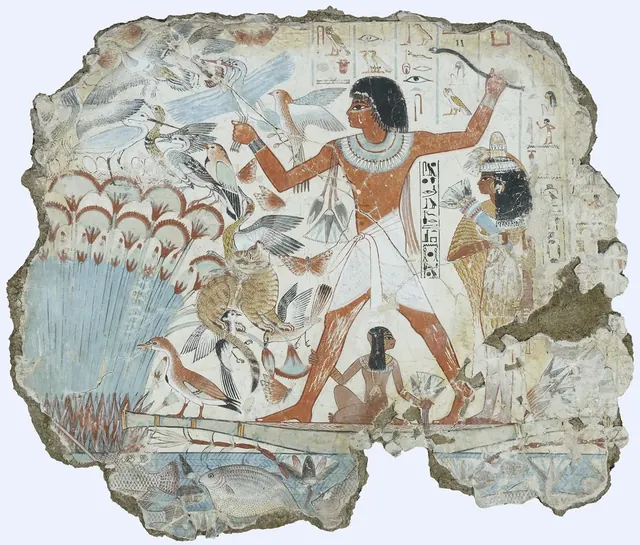
Nebamun hunts birds with his wife and daughter. The painting decorated his tomb-chapel at Thebes around 1350 BCE, where the living brought offerings and prayers. The plentiful plants and animals represented prosperity intended to continue after death. The hunting scene therefore concerns both earthly life and the life expected beyond it.
Nebamun is the largest figure. He spreads his feet across the narrow boat, raises a throw-stick and holds birds in the other hand. Scale identifies the chapel’s owner regardless of his imagined distance from a viewer. His shoulders appear broad while his head is in profile. Each body part is presented from an angle that makes it readily recognizable.
Nebamun’s wife Hatshepsut stands behind him. Her name is known from an inscription; she is not the famous queen of that name. Clothing, jewellery and flowers present the family formally. Because this is a tomb-chapel image, the costume should not be treated as a straightforward record of everyday hunting dress. The scene maintains the dignity and prosperity of its participants.
The daughter sits between her father’s legs, holding him with one hand. Her small figure fits within Nebamun’s great stride, keeping the family group compact. Despite the difference in scale, her hair, jewellery and hands are carefully painted. The conventional sizing communicates both family connection and the father’s central position. It organizes the account of these people clearly.
A cat hunts among the birds. Its spotted coat, extended paw and prey near its mouth are visible. In contrast to the stable human figures, the animals overlap at different angles, producing congestion and movement. Conservators found gold leaf on the cat’s eye. The British Museum notes how exceptional this is among Theban tomb-chapel paintings. The tiny detail once genuinely gleamed.
Fish appear beneath the boat, although water would obscure parts of their bodies in an ordinary view from the bank. Here the surface is effectively opened so that scales, fins and different species remain visible. Birds and papyrus above the water receive equally close attention. The artist gathers the abundance of the marsh into one field, choosing clarity for each inhabitant.
Closely spaced papyrus stems rise into fan-shaped heads. Against this ordered vegetation, birds take flight in different directions. Repeated verticals make the wing movements and angled necks easier to distinguish. The plants form a habitat while organizing the picture. Abundance emerges through many carefully differentiated forms rather than a single general sign for nature.
The irregular edges remind us that this is a fragment removed from a wall. A largely lost fishing scene once stood beside it. The chapel brought several such images together, and its original visitors encountered them in connection with offerings and remembrance. A museum photograph allows close examination, but understanding the work requires also recalling its lost surroundings. Whose life received this kind of remembrance? The owner’s large figure and the smaller scale of others display a strongly hierarchical society. The painting preserves one person’s name and prosperity. Those whose labour sustained that prosperity remain largely outside the scene. A funerary image can reveal hopes for life after death alongside the distribution of wealth and standing among the living.
- Medium
- Paint on plaster
- Collection
- British Museum, London
- Accession number
- EA37977
Sources
Reproduction of a public-domain artwork. Image licence