The Arnolfini Portrait
Jan van Eyck · 1434
Explore the painting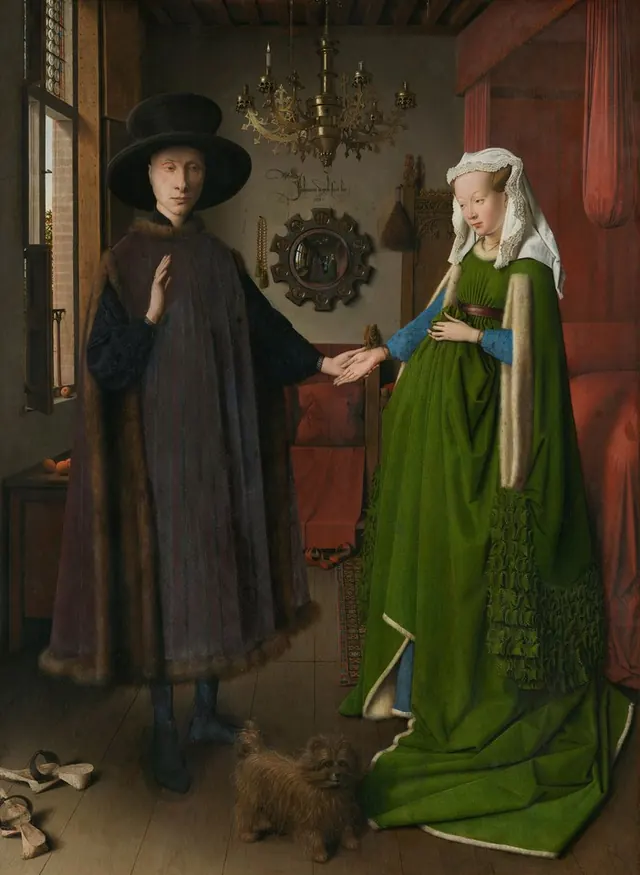
In 1434 Jan van Eyck painted a couple in a richly furnished room. The man is usually identified as Giovanni di Nicolao di Arnolfini, an Italian merchant working in Bruges. The woman’s identity is less clear. The painting was long treated as a wedding document. The National Gallery now describes it as a double portrait of a married couple. Setting and clothing present their family standing and prosperity to visitors.
The man’s raised hand may be a greeting. Dark fur-trimmed clothing and a broad hat give him presence. Wealth is expressed without a crown, a coat of arms on his chest or a weapon. The standing of a prosperous townsman matters here. Expensive fabrics and a restrained pose offer a particular image of social reliability. For a merchant whose business depends on trust, this way of presenting himself had particular value.
The woman gathers heavy green fabric before her. The resulting shape has often been mistaken for pregnancy, but it is produced by the gown. Its long train occupies much of the floor, and fur borders the sleeves. The clothing requires a large quantity of expensive material. A garment unsuited to work becomes a way of displaying the standing of someone who need not labour while wearing it.
The joined hands lie between the two figures. Their pale forms remain clear against the dark costume and green gown. The gesture connects the people across differences in dress and pose. One hand addresses those outside the couple, while the other maintains a connection within it. Their domestic union is also presented to those standing at the entrance—and to us in their place.
The convex mirror returns the couple’s backs and two more figures near the entrance. Space continues where we stand. Above it a Latin inscription states that Jan van Eyck was here. The signature becomes part of the domestic wall. The painter shows the room while reminding us of his presence in making it. Several viewpoints meet: those of the couple, the visitors and the painter, whose name occupies a conspicuous position within the room.
The small dog looks directly towards us. It was added late over an already established space, as were several objects. Fine strokes describe fur and pale dots give the eyes moisture. The detail feels like life caught by chance, although it was deliberately introduced. The room works similarly: its objects are convincingly painted, but not all could fit within the space shown.
Oranges, carved furniture and the red bed displayed wealth to visitors. The museum explains that the bed belonged to a reception room and was itself an expensive object for display. Our familiar distinction between intimate bedroom and public presentation does not apply here. The painting shows domestic life becoming a statement of family standing. Its almost tangible precision makes that statement particularly persuasive.
- Medium
- Oil on oak
- Collection
- National Gallery, London
- Dimensions
- 82.2 × 60 cm
- Accession number
- NG186
Sources
Reproduction of a public-domain artwork. Image licence