The Creation of Adam
Michelangelo · 1508–1512 (Sistine Chapel ceiling cycle)
Explore the painting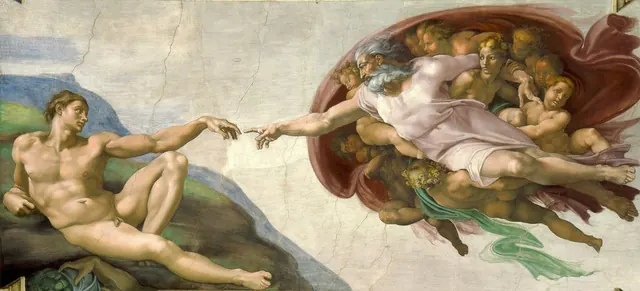
This episode stands high above the floor of the Sistine Chapel. Pope Julius II commissioned Michelangelo to paint its ceiling in 1508; the work was completed in 1512. Among nine Genesis scenes, the Creation of Adam shows the first human coming into being. A vast religious account is concentrated in two bodies and the small distance between their hands. The familiar isolated reproduction originally belonged to a much larger ensemble.
Adam rests on the earth with one leg extended and the other bent. His body is already beautifully formed, yet his wrist remains relaxed. Michelangelo, also a sculptor, makes anatomy the principal means of narration. Muscles and joints convey weight. Physical beauty relates to the biblical understanding of humanity as created in God’s image.
A narrow gap remains between the index fingers. The Creator’s arm stretches more actively, while Adam’s wrist droops. The small difference makes the giving of life readable as an action between two differently placed participants. The biblical text contains no such description of fingers. This clear visual formulation is an artistic decision translating an invisible event into bodily gesture.
The Creator moves towards Adam with the surrounding group. His head and arm point in one direction while the legs extend towards the opposite edge. Adam has support on the ground; the airborne group has none. Bodily tension and moving fabric distinguish these conditions. Large forms keep the event legible even from far below the ceiling.
A red mantle encloses a dense group of figures identified by the Vatican Museums as angels. In 1990 physician Frank Meshberger proposed a different reading. He saw the anatomy of a human brain in the group’s outline and connected the scene with the gift of intellect. This is a researcher’s hypothesis, not an established explanation by Michelangelo. It invites a comparison: how does the gesture change if we understand it as giving the ability to think? The resemblance permits this reading without proving a concealed intention.
Green fabric trails freely beneath the group. Its line reinforces flight and continues the direction of the legs. Beside the large bodies it is a thin, mobile element. Michelangelo uses the difference between the weight of human form and the lightness of drapery. Movement becomes palpable without filling the sky with objects or landscape detail.
The slope beneath Adam consists of broad areas. It offers little as an independent landscape; the earth primarily supports the body. That distinction matters within the ceiling’s programme. Humanity belongs to the created world but receives a special position through the gesture directed towards Adam. This hierarchy belongs to the Christian account within which Michelangelo worked.
A modern viewer may see a religious event, admiration for the human body or an image of contact not yet completed. These readings draw on different parts of the work. The commission nevertheless came from a pope for an active chapel. Isolating the fingers on an advertising poster preserves the gesture’s clarity while changing its setting and purpose.
- Medium
- Fresco
- Collection
- Sistine Chapel, Vatican Museums
Sources
Reproduction of a public-domain artwork. Image licence