The Kiss (Lovers)
Gustav Klimt · 1908 (completed 1909)
Explore the painting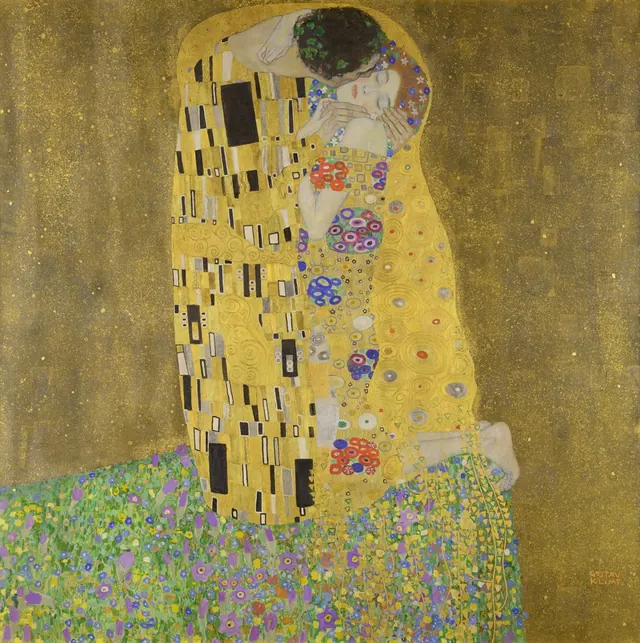
In 1908, Klimt exhibited an embracing couple surrounded by gold in Vienna. The Austrian state acquired the work for the Modern Gallery during his lifetime. An intimate subject immediately gained a public museum role. Faces, hands and feet make the people recognizable, while patterns conceal most of their bodies. That combination makes the embrace feel both physical and stylized.
The man bends towards the woman’s face; her eyes are closed. Soft shadows describe cheek, chin and shoulder. Nearby, conventional spatial clarity ends. The clothing forms an immense shared shape in which the positions of both bodies are difficult to follow. Klimt leaves enough human detail to recognize the gesture and turns the rest into surface pattern.
The woman’s arm reaches around the man’s neck. Other hands gather near her face, connecting the figures across the ornament. Touch is especially legible at these points. The gestures allow discussion of intimacy, reciprocity or unequal positions, but cannot establish the couple’s biography. Popular identifications of Klimt and a particular lover remain hypotheses. The painting provides no secure portrait identification for both figures.
Black, white and gold rectangles repeat across the man’s clothing. Their edges seldom follow the folds we might expect. We see both a covered body and a flat mosaic of elements. In his Golden Period, Klimt used real metal, which reflects light differently from paint representing a shine. Under museum lighting, the surface changes with the viewer’s position.
Rounded coloured shapes fill the woman’s dress. Their difference from the rectangles distinguishes two people within the shared golden mass. These patterns are often read in terms of masculine and feminine principles. That interpretation is discussable, but does not make every circle a universal feminine sign. Within the picture, pattern establishes difference while also connecting surfaces.
The flowering meadow ends beside the woman’s feet. Beyond it lies a golden field with no landscape horizon. The edge may suggest instability even though the couple occupies a stable centre. Different emphases are possible: the shelter of a shared embrace or the narrowness of the ground beneath them. Both responses arise from the composition; neither proves one exclusive intention.
Small metallic particles are visible in the open background. Their shine draws attention to the surface itself. The Belvedere connects Klimt’s language with Byzantine mosaics, medieval gold grounds and East Asian decorative arts. Those traditions served different purposes. Here their devices participate in a secular painting of a couple within Viennese modernism.
Gold helped make the painting recognizable far beyond the museum. Reproductions often turn it into yellow, losing the material difference. An image of love suitable for cards or advertising remains. The original embrace is more complex. Distinct patterns, concealed bodies, the meadow’s edge and reflective metal sustain a longer reading than its familiar souvenir silhouette.
- Medium
- Oil, gold and other metallic materials on canvas
- Collection
- Belvedere, Vienna
- Dimensions
- 180 × 180 cm
Sources
Reproduction of a public-domain artwork. Image licence