Adoration of the Mystic Lamb — original central panel of the Ghent Altarpiece
Hubert and Jan van Eyck · Completed 1432
Explore the painting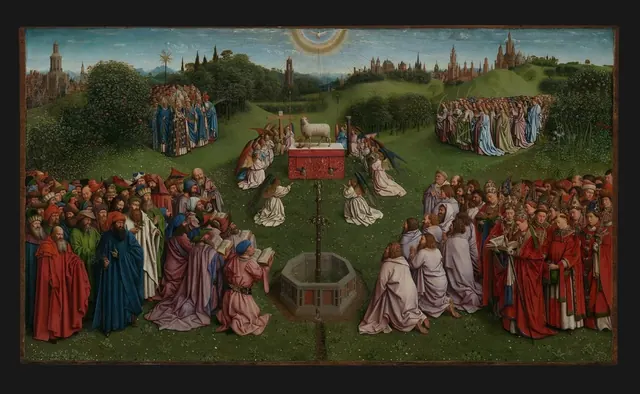
On this panel of the Ghent Altarpiece, many people gather around a small white lamb. It represents Christ offering himself in sacrifice. The complete ensemble was finished in 1432 for the chapel of Joos Vijd and Elisabeth Borluut. An inscription credits Hubert van Eyck with beginning it and Jan with its completion. A private donation took the form of an immense image of the Christian world intended for worship.
The lamb stands on an altar, with blood flowing from its breast into a chalice. Gospel sacrifice is connected with the Eucharist celebrated at the actual altar. The animal looks outwards with an almost human expression. Later overpainting concealed this feature for centuries. Conservation completed in 2019 recovered the earlier face. Its unfamiliarity reminds us that previous generations could know a substantially altered work.
The fountain before the altar continues the central axis. Its octagonal basin is seen from above, revealing water and the structure of its stone sides. A narrow stream runs towards the viewer. Water participates in the Christian imagery of salvation and life, yet is painted as material, flowing water. Spiritual meaning gains persuasive force through things the eye recognises from experience.
At left people stand and kneel, open books and turn their heads. Their shared direction towards the altar does not erase differences of face and dress. Multiplicity and unity matter together. Individuals retain signs of belonging while entering a common order of worship. This makes the complex panel readable despite its dozens of figures and many small objects.
At right simple pale robes stand beside elaborate ecclesiastical vestments. Books, tiaras and mitres distinguish roles. The represented world is organised through a Christian system of dignity and holiness. It claims universality while showing it in particular historical forms. That tension matters: the promise of common salvation is expressed through a society where each person’s place and affiliation remain clearly marked.
A white dove appears in a radiance above the altar. Rays cross the open sky and connect it with the small lamb. A richly detailed green world spreads around this strict axis. Individual plants, trees and buildings can be studied one by one. Northern Renaissance painting makes religious space convincing through abundant visible things without abandoning their symbolic relationships.
Conservators removed identified later paint from the head but retained the lamb’s enlarged body contour. Research could not securely attribute that alteration to the original painters or an early intervention. Authenticity thus has a practical consequence. Returning everything to a presumed first state would destroy a layer whose history remains uncertain. Preserving it allows future investigation and reveals the responsibility involved in decisions about the past.
- Medium
- Oil on oak panel
- Collection
- Saint Bavo's Cathedral, Ghent
Sources
Research and educational use with attribution. For-profit use is not permitted. Central panel after restoration completed in 2019. Official visible-light macrophotography. Image licence