Eight Views of the Xiao and Xiang Rivers
Sekkei · Late 17th/early 18th century
Explore the painting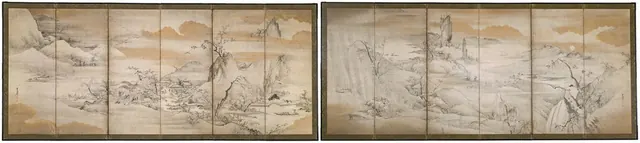
These Japanese screens present a Chinese landscape that had long become a literary theme. The Eight Views of the Xiao and Xiang Rivers emerged in eleventh-century Chinese poetry and painting. Japanese artists later made them a principal subject of ink landscape painting. Working around the turn of the eighteenth century, Yamaguchi Sekkei addressed viewers who could recognise combinations of place, weather and time from poems and earlier images.
A steep slope rises on the left, lightly indicated in grey ink. Natural forms are assembled without a single fixed viewpoint. The screen encourages successive movement from one area to another. Looking resembles reading a cycle of poems in which a shared region appears under changing conditions.
Small buildings stand among the trees. Their scale establishes an inhabited world within the mountains. The cycle names rivers in what is now China’s Hunan province, but Japanese viewers did not need to travel there. Literary familiarity made the place recognisable through an established set of motifs.
Mountain paths and trees continue across the folds. Six panels physically divide each screen, while the painting connects them into an extended space. The object both organised a room and introduced a distant landscape into it. Its size and folding angle could alter the relationships between painted passages.
High rocks retreat towards the middle of the right screen. Farther right, a small pale disc appears above the mountains. This is the autumn moon over Lake Dongting, one of the eight views. For someone familiar with the tradition, a tiny sign identifies an entire poetic episode.
The tree at the right edge uses dark lines against pale mountains. Variations in ink density establish depth without bright colour. Sekkei trained within the Kano tradition before working independently. His respect for earlier models preserved recognisable devices of Chinese landscape painting.
At the left of the right screen, fine rain streaks surround a solitary boat. This is another episode, Night Rain on the Xiao and Xiang Rivers. Different views, weather conditions and times of day share this pair of screens. Their juxtaposition offers successive experiences of a region familiar through poetry.
Golden clouds connect the ink landscape to the decorative surface of a Japanese interior. The familiar Chinese subject gains different materials and scale. Respect for an older culture coexists with its active adaptation to another household and society. The journey takes place between poetry, painting and the room in which the screens stand.
- Medium
- Pair of six-panel screens; ink and gold on paper
- Collection
- Art Institute of Chicago
- Dimensions
- Each, 170.2 × 381 cm
- Accession number
- 1968.416-417
Sources
Image provided under CC0. Image licence
Adapted and translated from Art Institute of Chicago materials. · Text licence