Bamboo
Kishi Ganku · early 19th century
Explore the painting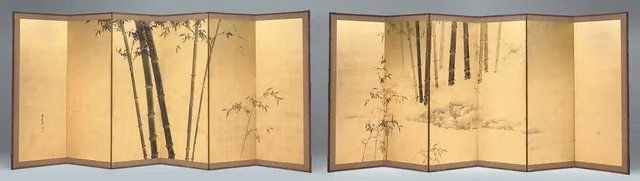
This early-nineteenth-century pair of screens could surround a viewer with bamboo inside a room. Kishi Ganku retained large stalks, a few leaves and a pale bank. The museum proposes an original set of five pairs arranged around rooms for gatherings of educated art lovers. Participants may have likened themselves to China’s legendary Seven Sages of the Bamboo Grove, an admired model of free intellectual exchange.
Thick stalks cross the left screen’s lower edge and rise beyond it. We seem close to plants whose tops exceed our view. Ganku moved an ink-loaded brush evenly, forming a long section in one movement. Crosswise nodes divide each stalk into segments.
Thin leaning stems differ from weighty verticals. Varied widths and directions suggest living growth through few elements. Gold absorbs little ink. Where the brush skipped across its surface, broken texture could resemble bamboo’s natural skin.
A small leafy branch enters open space. Surrounding gold exposes each brush movement. Animal glue also modified the ink’s behaviour. Surface material and paint composition contribute to light on the stalks alongside drawing, through their direct interaction.
Stalks on the right rise densely from a bank. Their bases remain visible while tops are again cropped. Two screens offer different levels of looking at one grove. Arranged closely around a room, partial views could suggest continuous space surrounding the gathering.
The bank is paler than the tall stems. Diluted ink indicates uneven earth beside water without filling every surface. Actual folds alter the angles of gold planes, so room lighting continually changes the painted grove’s appearance.
Such decoration allowed owners to place themselves within an admired model of scholarly leisure. Costly gold supported economical painting. Visual simplicity and an expensive object reinforced one another. If the five-pair reconstruction is correct, landscape became a shared setting for conversation, gaining meaning through people’s presence as well as recognition of bamboo.
- Medium
- Pair of six-panel screens; ink and gold leaf on paper
- Collection
- Art Institute of Chicago
- Dimensions
- Each, 178 × 376 cm
- Accession number
- 1967.378-1967.379
Sources
Image provided under CC0. Image licence
Adapted and translated from Art Institute of Chicago materials. · Text licence