Fishing Boats with Hucksters Bargaining for Fish
Joseph Mallord William Turner · 1837–38
Explore the painting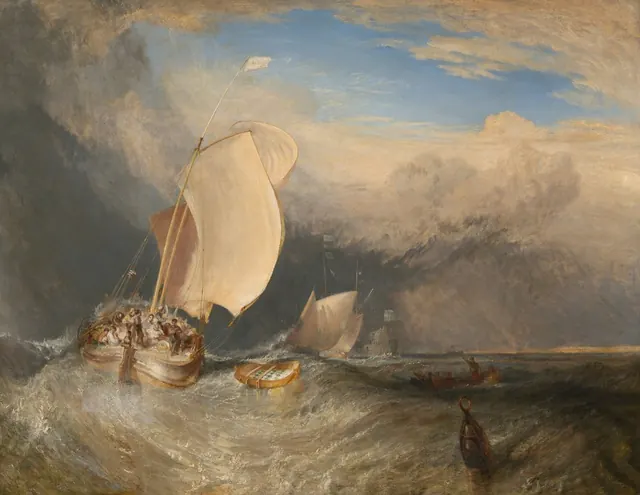
Fishermen and buyers meet on rough water. A small boat carrying dealers approaches the larger vessel to purchase a catch for resale in port. Turner chose an economic encounter dependent on weather and the ability to keep a boat steady. Painted in 1837–38, the work shows labour continuing among waves, wind and a gathering cloud.
A large pale sail rises against the dark sky. Its swollen form makes the force of the wind tangible. With the sloping mast it establishes movement before we distinguish the people. Turner placed his signature on the small white flag high above the deck, inserting his name into the seascape itself.
Small figures crowd the deck. Closely grouped and painted with brief touches, their individual poses are difficult to read at once. The title supplies what gestures alone cannot securely establish: bargaining for fish. The economic activity remains specific while separate faces almost merge with the vessel's movement.
A low boat carrying people approaches from the right. Waves alternately reveal and conceal its gunwale. Even a short transaction involves exertion and risk. These buyers work far from a convenient marketplace. The scene can therefore be considered as an image of intermediaries' labour, bringing a catch towards the shore and its eventual consumers.
A distant sail repeats the bright shape of the larger one at a much smaller scale. The contrast opens a stretch of sea behind the main group. The museum also identifies a steamship in the distance, connecting the older sailing world with nineteenth-century industrial technology without making it the principal subject.
A dark buoy at the lower right rises above a wave. Its solid outline helps us judge the water's direction and the height of its crests. It is particularly close to us, yet offers no secure, stationary viewpoint behind it. We seem to observe from the same unstable environment in which the deal must be conducted.
Thickly applied paint catches the light across the foreground water. This technique, called impasto, makes the painted surface contribute to the impression of foam and glitter. Turner's material handling joins the sea's movement, while more blended clouds form a broad atmospheric mass.
The composition continues the tradition of seventeenth-century Dutch marine painting, especially Willem van de Velde, whose work was popular in England. A low horizon and the boatmen's everyday activity connect Turner with that inheritance. His concentration on light and turbulent atmosphere raises a further question about what occupies the centre of our attention: the workers, or the spectacle of weather that almost obscures their faces?
- Medium
- Oil on canvas
- Collection
- Art Institute of Chicago
- Dimensions
- 174.5 × 224.9 cm
- Accession number
- 1922.4472
Sources
Image provided under CC0. Image licence
Adapted and translated from Art Institute of Chicago materials. · Text licence