Landscape of the Four Seasons
Sesson Shukei · About 1560
Explore the painting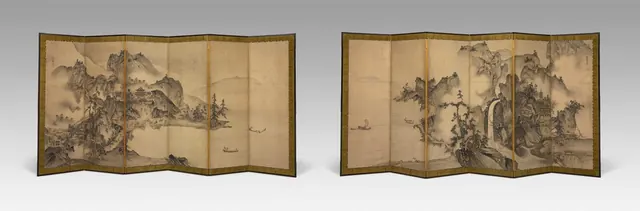
The monk-painter Sesson Shukei made this pair of screens around 1560. Travelling through eastern Japan, he developed an individual style away from Kyoto, the cultural capital. An imagined Chinese landscape unfolds from right to left, from early red plum blossoms to snow-covered peaks. Twelve panels connect seasonal change with a journey through one expansive world.
Mountains on the left rise in layers and dissolve into unpainted intervals. The seasonal cycle concludes here in snow. Dark rocks and pale spaces create depth through suggestions of air and mist. Actual screen folds bring passages physically closer or farther away.
Buildings stand among mountains connected by paths and shoreline. Human life, movement and retreat coexist. For Zen monks, an ideal landscape could offer a setting for unimpeded intellectual and religious practice. Imaginary distance made such a place available inside a room.
A small boat near the left screen’s lower edge establishes scale. Shore and mountains become immense beside it. Water connects distant places without a continuous road. The eye follows a possible human journey while remaining before a stationary surface.
Another boat crosses open water on the right screen. A broad inlet separates mountain groups. Its nearly empty surface carries attention between banks. Two distinct folding structures become one world continuing across their physical separation.
A waterfall descends between dark rocks and spreads at its base. Twisting stone formations seem unusually mobile. Sesson intensifies natural contours into expressive drawing. Even within a peaceful seasonal order, water and rocks retain sharp turns and surprising energy.
A temple occupies the mountains on the right. Architecture associates the setting with spiritual practice, while small figures and boats keep its surroundings lively. Retreat remains accessible by paths and water. The screens connect religious activity with a world through which people continue to travel.
Chinese models held special importance for Japanese Zen painting, associated with a teaching that originated in China. Sesson transformed them through a career in eastern Japan, creating a landscape belonging to several cultural spaces. Its seasons offer renewal and its details an imagined itinerary. A folding screen brings that ideal country into an everyday interior.
- Medium
- Pair of six-panel screens; ink and light color on paper
- Collection
- Art Institute of Chicago
- Dimensions
- Each, 174.2 × 357.2 cm
- Accession number
- 1958.167-168
Sources
Image provided under CC0. Image licence
Adapted and translated from Art Institute of Chicago materials. · Text licence