View of Cotopaxi
Frederic Edwin Church · 1857
Explore the painting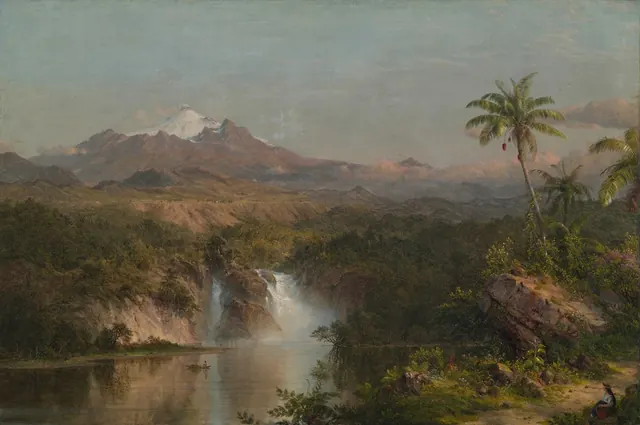
A snowy summit, tropical plants and a waterfall meet in one view of Ecuador. Frederic Edwin Church painted View of Cotopaxi in his studio in 1857, before his second South American journey. Alexander von Humboldt’s writings, which explained relationships between climate, altitude, vegetation and geology, encouraged his interest in the region. Landscape promised to make these connections visible together.
Cotopaxi’s white summit rises above successive mountain ranges. Snow beside tropical greenery reveals differing conditions at different altitudes. Church closely studied places during his travels, then organised his observations into large finished compositions. Studio work let him combine nearby detail with an exceptionally distant view.
The waterfall occupies the centre of dark vegetation. White water guides the eye from the mountainous interior towards the still surface below. For mid-nineteenth-century viewers, such a spectacle could join scientific curiosity with religious awe. Church and part of his audience understood natural forces as evidence of divine power.
The tall palm on the right provides a nearby vertical reference. Its leaves are distinct against the sky, while atmosphere softens distant slopes. Botanical detail and an extended prospect let viewers study nature close at hand while surveying an enormous territory.
A small boat carrying a person rests on the water. Its scale nearly disappears before waterfall and mountain. Local inhabitants are present, but they do not organise the view. The principal perspective belongs to someone granted a sweeping survey of the land. That position matters to the painting’s meaning.
A path on the right bank leads towards the landscape’s edge. Flowers and stones appear close enough to approach. Such visual accessibility brought a distant region near to a North American audience. It could also support the idea of another people’s territory as open to investigation and development.
A small seated figure appears beside the path, reminding us that this world is already inhabited. Mid-nineteenth-century US interest in Latin America included ambitions to expand influence and territory. The museum proposes considering this political background alongside the landscape’s scientific and religious foundations.
A distant plain links the green foreground to the volcano’s slopes. Our eyes cross it easily, although an actual journey required time and effort. The painting makes a complicated region into an accessible visual whole. That convenience has a perspective: the world is organised for a visiting observer.
Church repeatedly returned to Cotopaxi in finished works. This version balances still water and snowy summit, allowing the volcano’s destructive force to recede from attention. Its completeness remains selective. Science, faith and a political gaze converge, while local experience occupies only a small part of this expansive account of the country.
- Medium
- Oil on canvas
- Collection
- Art Institute of Chicago
- Dimensions
- 62.2 × 92.7 cm
- Accession number
- 1919.753
Sources
Image provided under CC0. Image licence
Adapted and translated from Art Institute of Chicago materials. · Text licence