Adoration of the Magi
Sandro Botticelli · 1470–1475
Explore the painting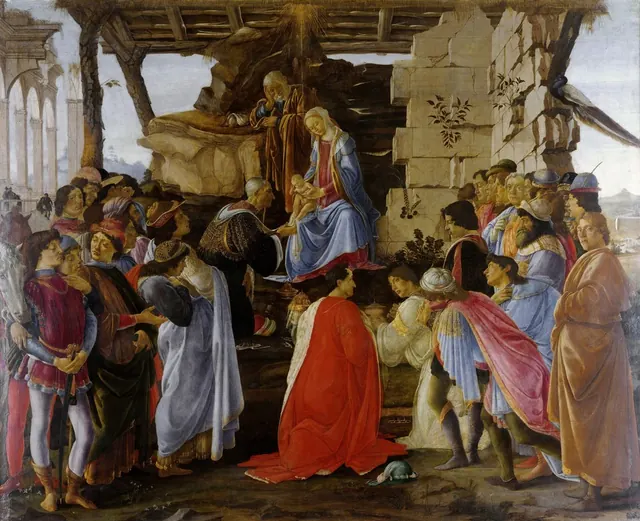
Prosperous Florentines surround the infant Christ. Among them are members of the Medici family and the patron, Gaspare del Lama. A businessman associated with the moneychangers’ guild, he established a chapel in Santa Maria Novella. Botticelli painted a biblical scene with contemporary faces for its altar. Worshippers could recognise people who shaped their own city within the sacred story.
Matthew describes visitors from the East who followed a star and brought the child gold, frankincense and myrrh. In Florence this story also belonged to public life. The confraternity of the Magi organised costumed processions through the city to San Marco, and the Medici were members. Familiar faces within the Adoration therefore had a context that a local audience could recognise.
Mary holds Jesus above the kneeling visitors. In Matthew they have come in search of a newborn king. Here they find a small naked child, while the Magi themselves wear heavy, costly fabrics. Botticelli makes their relationship legible through height and gesture. The adult bows and the infant raises his hand in blessing.
The oldest Magus touches Christ’s feet through a cloth. His profile is set close to the infant’s delicate features. Vasari recognised Cosimo the Elder de’ Medici in this figure. Cosimo died in 1464, before the panel was painted. His presence among the Magi brings people from different times together in an image of devotion and family remembrance.
Below Mary, two Magi turn towards one another. One man’s red cloak spreads across the ground; the other’s white clothing stands out in shadow. They are tentatively identified as Cosimo’s sons Piero and Giovanni. Their turn also connects the two halves of the crowd. The eye can move from red fabric to white, then upwards towards mother and child.
The white-haired man on the right looks out and points towards himself. This is Gaspare del Lama, linking the panel to the person who paid for the chapel. His name recalled Gaspar, one of the Magi. A personal patron saint, the chapel’s dedication and the commissioner’s recognisable portrait came together within the same altarpiece.
Del Lama’s portrait allows two compatible readings. He takes part in an act of worship while preserving the memory of his donation. The Medici presence gives that remembrance political significance. We can discuss how the image serves its patron’s prestige without treating a portrait as proof that his devotion was insincere. Religious life and social standing are closely connected here.
The man in ochre at the far right also faces us. He is thought to be a possible self-portrait of Botticelli. His body turns towards the gathering while his head turns towards the viewer. This pose lets him belong to the scene and meet the gaze of someone standing before it. The familiar self-portrait device alone cannot prove his identity.
Columns, broken masonry and a timber canopy stand behind the crowd. Their different surfaces establish the gathering’s setting. The people do not fill every part of the space. A passage remains between the groups below, while heads rise at different heights. Botticelli allows many portraits to be examined without losing a clear path towards the principal group above.
The commission helped establish Botticelli’s reputation as a portraitist. Del Lama’s fortunes were less secure. He was convicted of fraud in 1476; the chapel later changed hands and the painting entered the Medici collection. The altarpiece preserved the company its patron had arranged during his lifetime. His own likeness, the honoured family and the subject of the Gospel story can still be considered together.
- Medium
- Tempera grassa on wood
- Collection
- Gallerie degli Uffizi, Florence
- Accession number
- 1890 n. 882
Sources
Public-domain faithful reproduction under Wikimedia Commons PD-Art assessment. Image licence