The Crucifixion with a Carthusian Monk
Workshop of Rogier van der Weyden · 1460
Explore the painting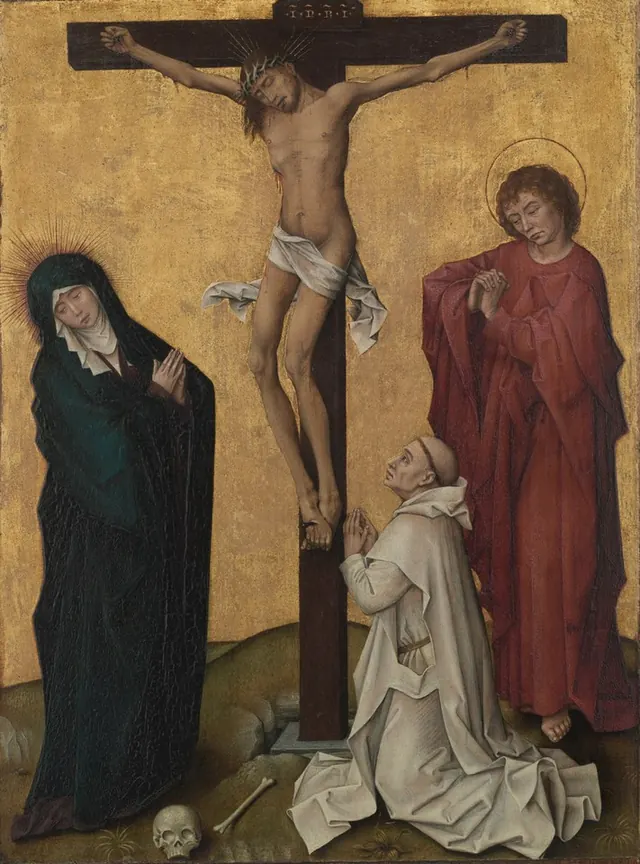
A Carthusian monk prays at the foot of the cross. This small panel was painted in Rogier van der Weyden’s workshop around 1460; its maker is unknown. It probably belonged in a monastic cell. Carthusians spent much of their lives in solitude, observing silence and concentrating on prayer. An image of this kind helped them return to Christ’s Passion daily.
The monk kneels very close to Christ’s feet. His white clothing, hood and broad front panel identify his order. His face turns upward, with joined hands continuing that movement. The painted worshipper could provide a model for the person facing the panel in his cell.
Christ’s head falls towards his shoulder. Blood runs from the wound and ribs show beneath the skin. Physical details give the viewer places to pause within the suffering. The pose remains clear and recognizable, allowing close attention to a detail to sustain memory of the entire Gospel event.
Mary lowers her head and joins her hands at the left. Dark clothing gives her silhouette density, while the white edge of her veil brings out her face. Restrained movements convey grief. Beside Christ’s exposed body, his mother’s enclosed figure presents another response to loss through stillness and prayer.
John interlaces his fingers before his chest at the right. Large folds of his red mantle balance Mary’s figure. His lowered gaze differs from the monk’s uplifted face. The painting offers several ways of being present at one event without making its witnesses respond identically.
A skull and a long bone lie on the ground. Their pale surfaces echo the monk’s clothing and Christ’s body. Death occupies the painting’s nearest space. Together with bare, stony soil, these remains make the execution site tangible, although a gold background without ordinary depth extends behind the figures.
If the panel was indeed kept in a cell, a monk could have prayed before it daily. The monk within the painting shortened the distance between the fifteenth century and Calvary. Today the object is seen in a museum, where attention often turns to authorship and style. Its small size recalls an earlier viewer returning for years to the same faces and gestures.
- Medium
- oil and gold on wood
- Collection
- Cleveland Museum of Art
- Dimensions
- Image, 37.1 × 27.3 cm
- Accession number
- 1931.449
Sources
Image provided under CC0. Image licence