Lindisfarne Gospels: carpet page
Attributed to Eadfrith · About 700
Explore the painting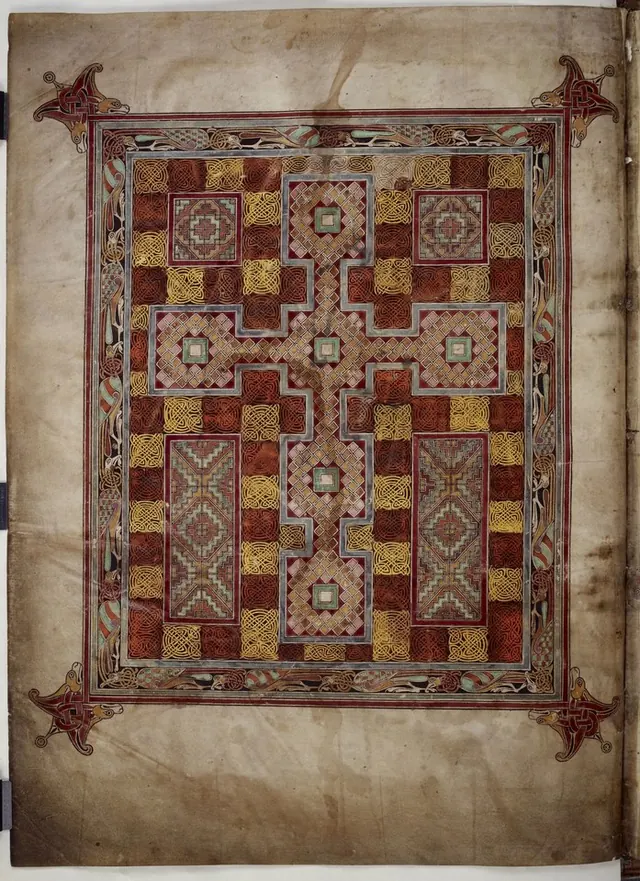
This book of the four Gospels was made around 700, probably at the monastery on Lindisfarne, off the Northumbrian coast. Its scribe is identified in a note added only in the tenth century. The priest Aldred records that Bishop Eadfrith wrote the book to honour God and Saint Cuthbert. Most scholars accept this attribution. This is the first of five carpet pages, leaves filled with ornament.
This page precedes Saint Jerome’s letter to Pope Damasus, known by its opening words, Novum opus. The cross therefore greets the reader before the Gospel narrative. Its pale border makes it immediately legible among hundreds of lines. Pattern fills both the cross and the surrounding space; closer viewing turns the large sign into many small paths for the eye to follow.
Yellow and red knots alternate in separate compartments. Bands pass over and under their neighbours although the parchment is flat. We can choose a line and follow it to the next knot. The difference becomes particularly clear between recognizing the cross at once and slowly examining how its pattern has been made.
Heads with eyes and long snouts appear in the upper band. Narrow bodies extend from them into neighbouring knots. Animal ornament also belonged to Germanic art, while interlace connects the page with other traditions of Britain and Ireland. Scholar Janet Backhouse noted how the book joins these with the late antique heritage of the Mediterranean. The island monastery participated in an exchange of images and knowledge.
In the lower-left rectangle, lines turn at right angles. Stepped bands form diamonds and crosses. The adjacent interlace is rounded and tightly packed, while this design reads in larger units. The artist changes the rules from one area to another. Treating the entire page as a single repeating pattern would make these differences easy to miss.
At the upper-right corner, a knot projects beyond the rectangular frame. Two heads face different directions, and red bands connect them to the page’s edge. The outer border has turns, colours and creatures of its own. Even a place that could have ended with a plain line becomes a separate, elaborate design.
The pale margins remind us what this work was made on. The book contains more than 250 parchment leaves made from calfskin. Skins had to be prepared, pages ruled, and text copied and decorated. Aldred also named Ethelwald, who bound the book, and the hermit Billfrith, who adorned its cover with metal and gems. Behind Eadfrith’s name were several people’s work and the community’s material resources.
More than two centuries later, Aldred added an Old English translation between the Latin lines. This carpet page remained without text, but the book continued to change for new readers. It offers a concrete reason to reconsider the idea that medieval religion simply obstructed art. Here monastic faith gave purpose to an immense artistic undertaking, which later generations preserved and supplemented with a translation.
- Medium
- Manuscript painting on parchment
- Collection
- British Library
- Accession number
- Cotton MS Nero D IV, f.2v
Sources
British Library rights statement: public domain in most countries other than the UK. Technical scales outside the leaf are cropped out. Image licence