Rough Waves
Ogata Kōrin · ca. 1704–9
Explore the painting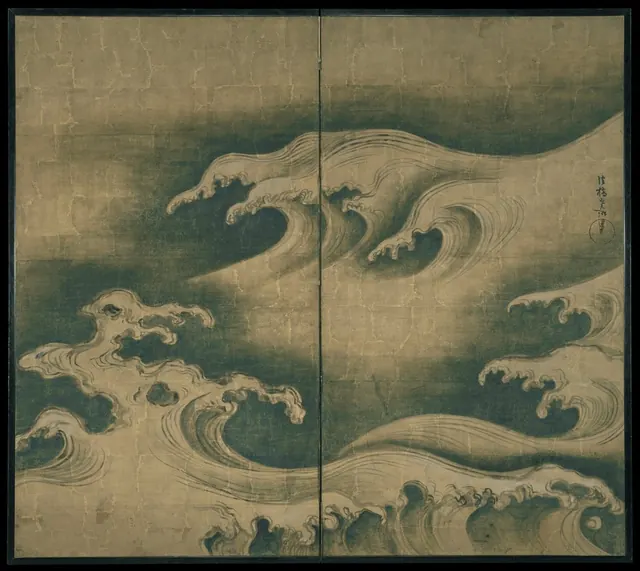
Ogata Kōrin turned moving water into an image for a two-panel folding screen. Made around 1704–1709, when he lived in Edo, it contains no ship, shore, or people. Waves occupy the entire surface. Clear contours hold their changing forms, while a gold ground retains its own radiance in place of a conventional seaward distance.
A high crest breaks into long extensions of foam, with rounded openings between them. Outlines recur without any curve exactly duplicating its neighbor. Water becomes a system of recognizable forms that produces a sense of continuous movement.
Fine parallel lines outline the foam. Kōrin used an old Chinese technique of drawing with two brushes held in one hand, leaving two traces through one gesture. The recurring contour derives from a particular working method and gives fluid forms unusual clarity.
Dark water at the right is compressed between pale crests. Gradual color transitions are absent. The adjacency of broad fields makes the waves’ rhythm abrupt. From a distance, the screen appears as a forceful pattern; close up, each edge reveals elaborate treatment.
A fold divides the two panels down the middle. When installed, the screen was not a flat painting. Its angle changed the spatial arrangement as viewers moved, while the gold surface responded to the room’s illumination. Painted water remained still, but its appearance shifted with a person’s position.
The Dōsū seal appears at the right. Kōrin adopted this name in 1704, helping establish the work’s date. The impression preserves information unavailable in the marine motif itself. It relates to a particular period of the artist’s life, while the waves identify no single recognizable shore.
Rinpa art connected painting with patterns on textiles, lacquerware, and ceramics, allowing natural motifs to move between objects. On this screen, a powerful sea becomes part of an inhabited room. The transformation supports two simultaneous impressions: water’s dangerous force and pleasure in its ordered pattern, made for close viewing.
- Medium
- Two-panel folding screen; ink, color, and gold leaf on paper
- Collection
- The Metropolitan Museum of Art
- Dimensions
- Image, 146.5 × 165.4 cm
- Accession number
- 26.117
Sources
Image provided under CC0. Image licence