The Lovers
Painting by Riza-yi 'Abbasi · dated 1039 AH/1630 CE
Explore the painting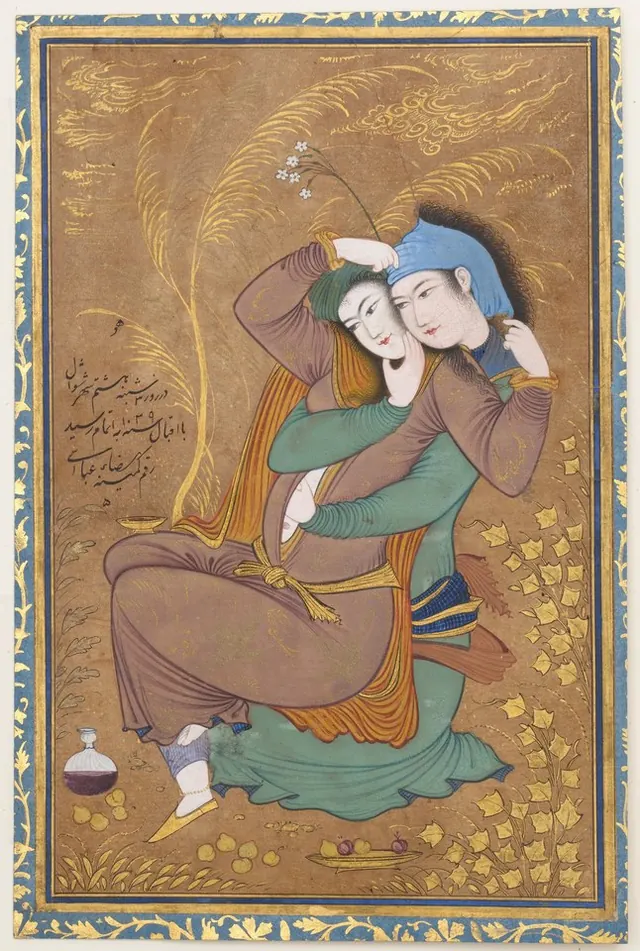
Riza-yi Abbasi painted this couple in 1630, late in his career at the Safavid court. They sit embracing among lightly drawn plants. The leaf is very small: the painted image is about eighteen centimetres high. Each figure, curve of an arm, and individual flourish invites close examination.
The faces press together while retaining separate outlines. Eyes turn downwards, and the brows and lips are drawn with fine lines. The painter presents no large action or succession of events. Attention rests on the positions of two bodies and their touching faces. The museum record does not establish the sitters’ identities.
The arm above the heads forms a broad curve, with fingers reaching towards the blue head covering. Other arms enclose shoulders and waist. Understanding the embrace requires following each sleeve in turn. The intricacy of joining two bodies is central to the drawing’s construction.
A green sleeve crosses the brownish garment. Colour separates the figures where their outlines meet closely, while both remain contained within a shared rounded silhouette. Individual arm movements belong to a larger enclosed form.
A vessel containing dark liquid stands below, with fruit nearby. These objects establish a setting without determining the couple’s exact location or biography. Their small scale suits the miniature leaf. Fine outlines keep them clear beside the larger area of clothing.
Gold plants curve across a nearly uniform brown background. Few signs establish depth: there is no detailed horizon or sequence of diminishing objects. Plant drawing surrounds the couple and repeats the flowing curves of their clothing. Space is organised chiefly through the placement of lines on the leaf.
The inscription at the left permits direct comparison between writing and drawing. Long sweeps, thickened strokes, and fine endings occur in both letters and the contours of cloth. The museum singles out Riza-yi Abbasi’s inventive use of calligraphic line as a characteristic of his work.
The museum links the sensual subject to greater acceptance of such imagery under Shah Safi. This is a historical interpretation; it does not make the leaf evidence of a particular love affair. The picture can be discussed both as a courtly image of intimacy and as an exploration of how two bodies join in an intricate design.
- Medium
- Opaque watercolor, ink, and gold on paper
- Collection
- The Metropolitan Museum of Art
- Dimensions
- Painting, 17.5 cm
- Accession number
- 50.164
Sources
Image provided under CC0. Image licence