Ophelia
John Everett Millais · 1851–1852
Explore the painting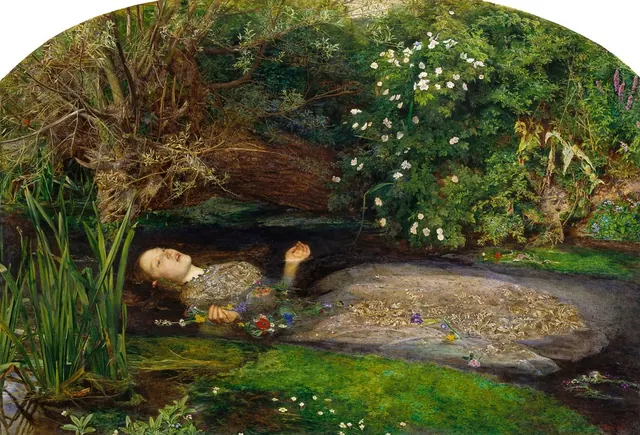
Ophelia is dying in the water, still supported by her spread-out dress. Millais chose an episode from Hamlet recounted by Queen Gertrude. The girl fell from a branch while hanging flowers, sang for a while, and was then pulled under by her waterlogged clothes. The painting holds the brief interval between falling and sinking. Knowing the literary outcome prevents us from seeing an entirely peaceful landscape.
The face lies just above the surface, the mouth partly open, connecting the image with the account of Ophelia’s singing. Elizabeth Siddal posed for the figure in a bath of water, allowing Millais to study the actual positions of head, hair and fabric. The literary character and living model must be distinguished. Posing gave the scene credibility without making Siddal’s biography a continuation of Shakespeare’s tragedy.
The palm faces upwards above the dark water. The hand does not grasp the bank. Together with the open mouth and still body, it helps convey the chosen episode. Yet the painting does not establish an intention to die. Shakespeare’s characters themselves discuss the circumstances differently. A depicted bodily position cannot resolve that literary question.
The dress spreads across the water in a broad oval. Its shining pattern remains visible, although parts darken and merge with reflections. In Shakespeare, clothing first supports Ophelia and then pulls her under. Millais presents the material as its role changes. Beautiful embroidery and the fatal weight of wet fabric belong to the same object.
Millais painted the bank, roots and trunk beside the Hogsmill River in Surrey. Landscape and figure were made under different conditions and joined on canvas. Close study of nature was an important principle for the Pre-Raphaelites, the group to which he belonged. Even bark and individual branches reward sustained observation. Work from life gives an old play’s episode a specific environment.
Pale flowers cover a bush above the water. Tall stems grow nearby, and separate petals float below. Plants belong to Ophelia’s words and actions in the play, making literary connections relevant. Yet every leaf need not receive an individual symbolic decoding. The detailed vegetation also describes an environment that continues to exist around a dying person.
Bright flowers lie on the dress and water, drawing attention beside the face and hands and making the tragic scene visually beautiful. A difficult question follows. Does beauty sustain attention to Ophelia’s death, or turn it into a convenient decorative image? Both responses are possible. The literary context keeps the event behind the appealing surface in view.
Millais painted the riverbank from life and added the figure in his studio. These separate activities became one brief scene from a play. The detailed plants invite us to linger beside the dying Ophelia. Around her, vegetation remains dense and flowering. The coexistence of continuing life and a person’s death makes the landscape part of the tragedy.
- Medium
- Oil on canvas
- Collection
- Tate, London
- Dimensions
- 76.2 × 111.8 cm
- Accession number
- N01506
Sources
Reproduction of a public-domain artwork. Image licence