The Sistine Madonna
Raphael · 1512–1513
Explore the painting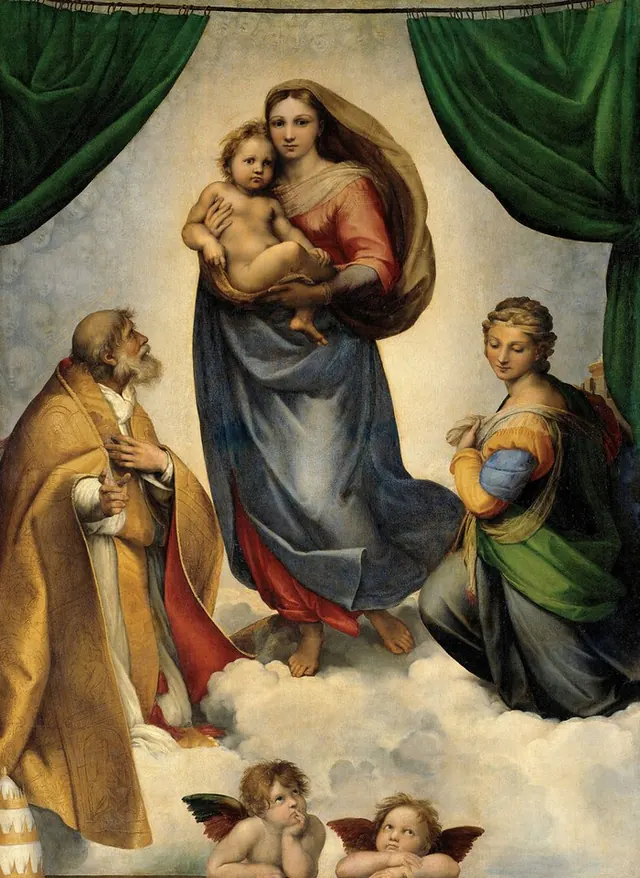
These two angels are often recognised before the whole painting. Yet Raphael made a large image for the high altar of the monastery church of San Sisto in Piacenza, most probably commissioned by Pope Julius II. Saints Sixtus and Barbara, venerated in that church, accompany Mary and Christ. The intended viewer stood before an altar. That position shapes the gestures, glances and even the lower boundary of the image.
Mary advances towards us. One foot moves forwards, fabric curves around her legs, and the child lies across her arms. Their bodies have weight although clouds lie beneath her feet. Raphael combines a mother’s recognisable movement with the impossible space of an apparition. Both faces turn outwards, placing us in their path. Their seriousness distinguishes the scene from an affectionate domestic image of mother and child.
Sixtus looks up at Mary and extends a hand towards people beyond the canvas. He links the apparition to the place of worship. His heavy gold vestment and kneeling posture convey reverence. The papal tiara has been removed and stands at the lower left. Even ecclesiastical authority appears before Mary as a petitioner. This visible distribution of roles was clearer within an altarpiece than in a detached reproduction.
Barbara turns towards the centre but looks down. Her glance leads towards the lower edge and the angels. Sixtus’s raised head and Barbara’s bowed head create different movements on either side of Mary. The composition is balanced without literally repeating poses. This is a characteristic achievement of the High Renaissance: a clear overall structure accommodates differences between living bodies and directions of attention.
The angels lean on the edge as though it belonged to the real space before the picture. Raphael added them late in the painting process. Their bent arms and upward eyes connect them with what happens above. Cropped onto a postcard, they can seem like independent children with nothing to do. In the altarpiece their waiting has an object. This familiar detail shows how cropping can change a pose’s meaning.
The green curtains are drawn apart and hang from a visible rod. They give the apparition the form of a vision opened for us. Numerous angelic faces can be discerned in the pale haze behind the figures. The background resembles cloudy air while also being populated by beings. The heavy fabric nearby helps us feel the distance between familiar material surroundings and this unusual space.
In 1754 Augustus III acquired the painting for Dresden. An altarpiece became a treasure of a princely collection and later a museum masterpiece. With its location, the reason for looking changed. We can value Raphael’s composition while noticing how museum recognition separates a work from the community for which it was made. The angels’ life on postcards continues that process on a smaller scale.
- Medium
- Oil on canvas
- Collection
- Gemäldegalerie Alte Meister, Dresden
- Dimensions
- 269.5 × 201 cm
- Accession number
- Gal.-Nr. 93
Sources
Reproduction of a public-domain artwork. Image licence