The Scream
Edvard Munch · 1893
Explore the painting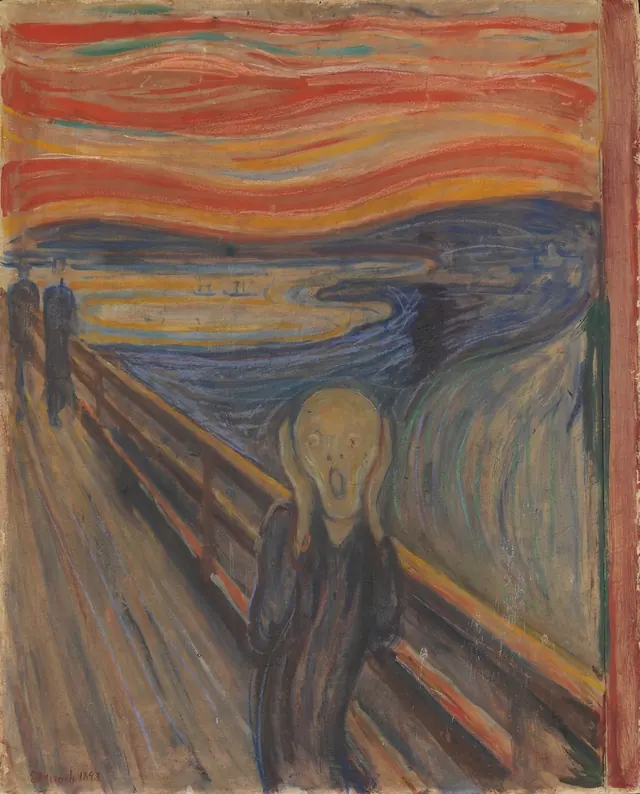
Munch connected this scene with a walk above the fjord at Kristiania, now Oslo. In an 1892 note, he described sudden anxiety and the sensation of a scream passing through nature. The open mouth therefore need not belong to someone making the scream. This is the National Museum’s 1893 version. Munch produced several versions of an image that gradually became a widely recognized sign of anxiety.
The face is reduced to a pale oval, dark eyes and an open mouth. In the earlier Despair, a recognizable man in a hat stood in a similar position. Here personal features have almost vanished. Neither age nor gender can be securely assigned. The simplification brings the response itself forward, allowing viewers to relate the image to their experience without knowing a character’s biography.
The hands press against the head, and the forearms continue into the body’s curves. Volumetric shading barely separates the parts; a long undulating outline joins them. The same pattern recurs around the person, so the gesture extends through more space than the figure physically occupies. The image’s overall construction conveys the experience.
Two companions continue along the road. Their straight silhouettes remain small and distinct. The railing’s diagonal establishes measurable distance between them and the foreground figure. In Munch’s note, his friends kept walking while the narrator stopped. The picture retains that separation without requiring invented accounts of what the two companions knew or felt.
Red, orange and yellow bands fill the sky. They curve over dark water, retaining visible traces of the applied materials. Munch dispenses with the smooth finish expected of an academic painting. The bands exist as an evening sky and as an insistent pattern. Their connection between form and experience explains the work’s place between Symbolism and Expressionism.
The shore and water continue the undulating movement. The railing remains almost the only long straight line in this part of the picture, making the surrounding distortions particularly noticeable. The road recedes, while the landscape on the right seems to rise onto the surface. Two spatial systems coexist, preventing ordinary perspective from settling the whole composition.
Near the lower edge, the support shows through the applied bands. This version uses tempera and wax crayon on cardboard. The materials do not disappear beneath a single smooth finish. Their varied textures sustain the image’s immediacy, although the motif developed through preparation and revision. A rapid impression does not mean an accidental process.
When first shown in Berlin in 1893, the painting was called Despair. Later mass recognition changed its reception, and the familiar figure now often eclipses the landscape. Returning to the whole reveals that the face alone does not convey the anxiety. Road, distance between people, railing and sky participate in the same event. Removing them would lose a substantial part of the account. The fame of The Scream makes it a convenient sign for almost any anxiety. Yet its construction is specific. Two figures continue along the path; curves of water and sky meet the straight railing, with the foreground person between them. This can suggest a separation between private experience and the surrounding world. The reading rests on composition without requiring a diagnosis of the artist.
- Medium
- Tempera and grease crayon on cardboard
- Collection
- National Museum, Oslo
- Dimensions
- 91 × 73.5 cm
- Accession number
- NG.M.00939
Sources
Reproduction of a public-domain artwork. Image licence