Isaac and Rebecca, Known as The Jewish Bride
Rembrandt van Rijn · c. 1665–1669
Explore the painting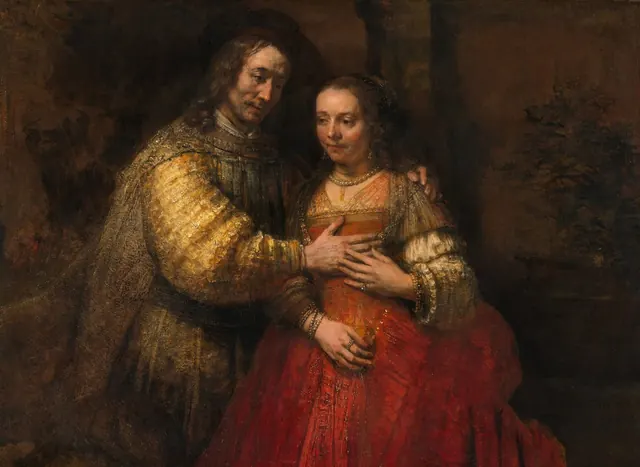
Two people in elaborate old-fashioned clothes stand together. The name The Jewish Bride came later than the painting. The Rijksmuseum associates it with Isaac and Rebecca, although the precise identification remains debated. Rembrandt painted the work around 1665–1669. Rather than a large biblical event, he presents an intimacy between two people that becomes visible through a single touch.
The man inclines his head slightly towards the woman. Uneven light allows his features to merge gradually into shadow. His eyes do not address us. This position separates the couple from the viewer even though they stand very close. We can observe a relationship without being invited into it. The absence of other figures concentrates our attention further.
Jewellery and a pale edging distinguish the woman’s face against the dark background. She looks in a different direction from the man; their gazes do not converge. Their connection is constructed through bodies and hands instead. Each remains a separate participant in this intimacy.
His palm rests against her breast, and her hand touches his fingers. His other hand encircles her shoulder. In the biblical reading this gesture has particular force. Isaac presented Rebecca as his sister because he feared for his life, but King Abimelech recognised from their intimacy that they were married. What words conceal, bodily movement reveals.
The red dress occupies much of the lower half of the canvas. Colour passes from the brighter bodice into deep folds. Small ornaments and seams provide occasional points of focus across this broad surface. Costume gives the figures historical distance. They may be Rembrandt’s contemporaries adopting biblical roles, but the identities of possible sitters have not been established securely.
The golden sleeve is built from thick paint. Light catches its ridges, making the fabric almost tangible. Close up, these are irregular deposits and grooves; at a distance they form an expensive garment. The skin beside them is handled more softly. Rembrandt changes the application of paint itself to distinguish heavy fabric, ornament and living touch.
The story of Isaac and Rebecca also introduces the vulnerability of private life before power. Yet the king who observes the couple is absent from the canvas. The viewer partly occupies his position. We admire intimacy while also inspecting something that could expose its participants. This reading follows from the museum’s proposed subject; without it, the painting still offers a compelling image of two people connected through touch.
- Medium
- Oil on canvas
- Collection
- Rijksmuseum, Amsterdam
- Dimensions
- 121.5 × 166.5 cm
- Accession number
- SK-C-216
Sources
Reproduction of a public-domain artwork. Image licence