Where Do We Come From? What Are We? Where Are We Going?
Paul Gauguin · 1897–1898
Explore the painting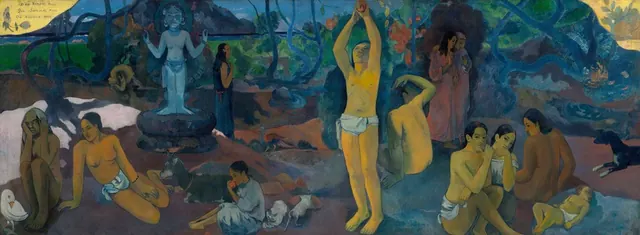
Gauguin painted this work in Tahiti during the winter of 1897–1898, amid a serious personal crisis. Several years earlier he had left France seeking a cheaper life and a society he imagined free from European modernity. The actual French colony failed to meet those expectations. In his largest canvas he assembled an imagined world under three questions about origin, existence and death.
A pale standing figure picks fruit with both arms overhead. Spanning almost the full height, it divides the extended group. The movement reads clearly at a distance, while the figure’s gender and exact role remain less definite. An ordinary gesture acquires a generalising scale. An affinity with the European motif of the fruit of knowledge suggests another reading: consciousness emerging through an act that also sustains life.
An infant lies at the right beside seated women. Gauguin explained movement across the painting from this edge to the opposite one as a passage from life’s beginning to its end. That reading rests on his own letters. Yet the groups do not form a sequence involving the same characters. Different conditions coexist, and viewers can connect them in another order.
At the left edge an elderly woman sits folded inwards, holding her head. In Gauguin’s explanation she is close to death. Her closed pose contrasts sharply with the fruit picker’s open movement. Age becomes visible through bodily position without an individual biography. The philosophical generalisation is therefore formally persuasive while leaving the character’s particular life untold.
A blue statue raises its arms behind the people. Gauguin associated it with the beyond. Its still frontal figure differs from the living bodies turned around it, while blue connects it to the landscape’s depth. This religious image belongs to the artist’s personal symbolic world. On a single surface he connects human age, animal life and an idea of existence beyond them.
A white bird stands near the elderly woman’s feet. In an 1898 letter to the painter George-Daniel de Monfreid, Gauguin described it as representing the futility of words. Beside a figure approaching death, this sign limits the hope of explaining human life through argument. A paradox emerges: the vast painting asks three questions while its author introduces an image of verbal answers’ inadequacy. An animal participates in the philosophical scheme alongside people.
The yellow upper corners resemble damaged edges of an old mural, although the canvas was made for a modern art world and exhibited in Paris in 1898. Gauguin gives his own work the appearance of an ancient testimony. This raises a substantive question about speaking for humanity. Tahitian figures serve a European author’s universal questions about life, while their own history under colonial rule almost disappears. The philosophical scale and that exclusion need to be seen together.
- Medium
- Oil on canvas
- Collection
- Museum of Fine Arts, Boston
- Dimensions
- 139.1 × 374.6 cm
- Accession number
- 36.270
Sources
Reproduction of a public-domain artwork. Image licence