Operating on Guan Yu's Arm
Katsushika Ōi · 1840s
Explore the painting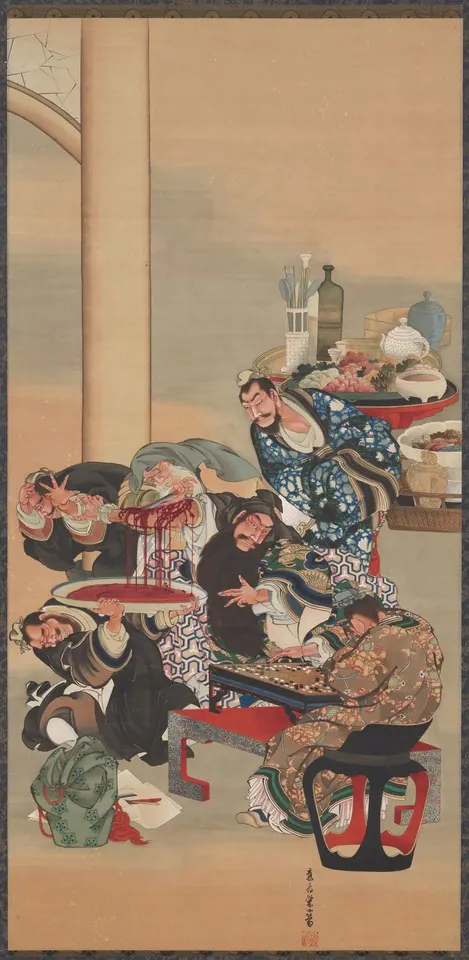
Guan Yu has poison scraped from his arm bone after an arrow wound, yet continues a board game. This episode comes from the Chinese novel Romance of the Three Kingdoms, also popular in Japan. Katsushika Ōi painted it in the 1840s. A historical third-century commander appears as a literary hero whose endurance exceeds ordinary human capacities. The painter makes that superiority visible through the behaviour of those around him.
The bleeding arm extends left while the other remains near the board. Two actions diverge from one body. The hero’s face turns towards the game, leaving the wound outside his attention. His long beard and heavy patterned clothing preserve dignity during a painful procedure. Ōi builds heroism from the difference between what happens to the body and where the person directs attention.
An elderly physician bends over the arm, working close to the wound. His curved posture contrasts with Guan Yu’s stable position. Beside him an attendant turns away and shields his face. Endurance is unevenly distributed: the doctor continues his work, the helper can barely tolerate the sight, and the hero attends to the game. Their reactions convey the operation’s pain without a separate explanation.
Blood falls in long red streams into a tray held by another attendant. His head turns away while his hands remain in position. He both recoils from the event and sustains necessary work. Bright red makes the procedure the principal visual incident. Even viewers who begin with the game return to this almost vertical flow.
The stones on the board preserve the order of a continuing game. An opponent sits opposite, leaning towards it. The board creates a small domain of rules and calculation within an ordeal of the body. Guan Yu can remain within that order as blood flows nearby. The more ordinary the activity appears, the stronger the hero’s exaggerated capacity to endure pain becomes.
A large pale wall occupies the scroll’s upper part. Bodies, fabrics, vessels and furniture gather much more densely below. Empty space increases the weight of that cluster and clarifies its gestures. Elegant patterns and carefully painted vessels coexist with a bloody detail. Ōi uses colour’s beauty to hold attention on a scene from which the depicted attendants themselves turn away.
Ōi was Hokusai’s daughter and worked alongside him. This is her largest surviving painting. Her independent command of a complex scene appears in each participant’s distinct action and in the colour connecting them into one event. Yet this celebration of masculine endurance opens another question. The hero’s extraordinary composure becomes convincing through other people’s labour and fear: the physician and attendants handle the material side of the feat.
- Medium
- hanging scroll; ink, color, and gold on silk
- Collection
- Cleveland Museum of Art
- Dimensions
- Painting, 140.2 × 68.3 cm
- Accession number
- 1998.178
Sources
Image provided under CC0. Image licence